Saniya Gazala
In short
To get your B2B SaaS recommended and cited by AI assistants like ChatGPT, Claude and Gemini, make sure they can find and read your pages, publish pages that answer your buyers' questions directly, and get listed on the sites their answers cite. Google says there are no special files or schema needed for its AI features: pages just need to be indexed and eligible to show with a snippet. Start by asking the questions your buyers ask, without your brand name, and noting who gets named and which sites the answers rely on. Then close the gaps one question at a time, and recheck every week.
On this page
- 01How AI assistants decide which products to name
- 02What I learned building an AI recommendation checker
- 03How to get your product recommended by AI, step by step
- 04What doesn't help
- 05Where Riposte fits, and where it doesn't
- 06Guides in this topic
- 07How I wrote this
- 08Sources
- ✓The bottom line
- ?Frequently asked questions
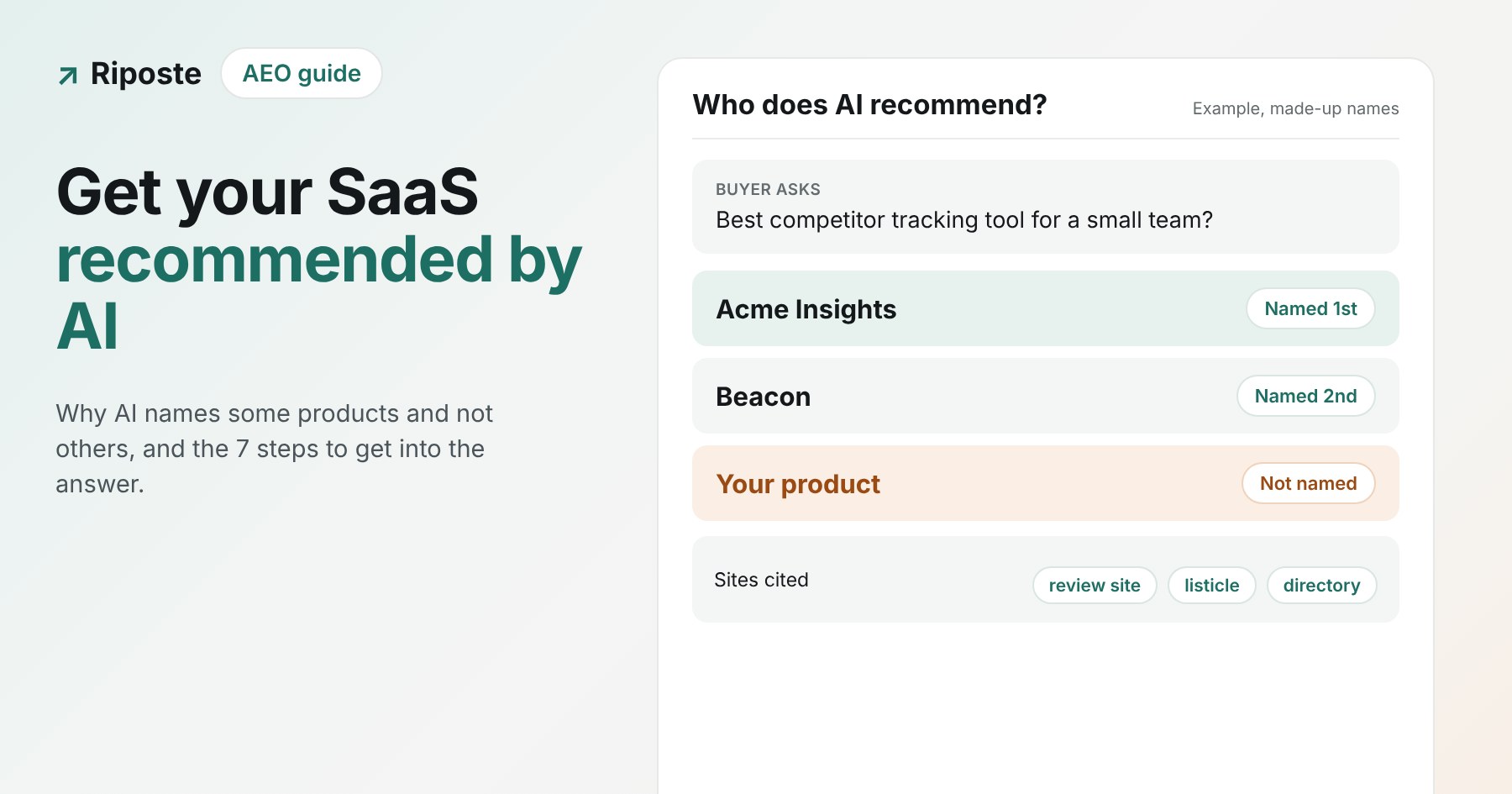
More buyers now ask an AI assistant "what's the best tool for…" before they visit a single website. If the answer names three of your competitors and not you, you lose that buyer without ever knowing they existed.
I've spent the last few weeks building an AI recommendation checker for Riposte, which asks buyer questions in Gemini with Google Search and records who gets named. This guide is what I learned building it, plus what Google and OpenAI say in their own documentation. No tricks, because there aren't any.
How AI assistants decide which products to name
An AI answer about software comes from two places:
- What the model already knows from the pages it was trained on.
- What it finds when it searches the web for your buyer's question.
You can't do much about the first one quickly. The second one you can work on today, and it's where most of this guide focuses.
Here's how the search part works, from the vendors' own docs:
- Gemini decides whether to search. Google's Gemini API docs say the model "analyzes the prompt and determines if a Google Search can improve the answer". If it searches, it writes its own queries, runs them, and cites the pages it used.
- Google's AI features run several searches at once. Google calls it "query fan-out": AI Overviews and AI Mode may issue "multiple related searches across subtopics and data sources" to build one answer.
- Only pages Google can show are used. To appear as a supporting link, a page must be "indexed and eligible to be shown in Google Search with a snippet".
- ChatGPT search needs its own crawler. OpenAI says sites that block OAI-SearchBot "will not be shown in ChatGPT search answers".
- So does Claude. Anthropic says Claude-SearchBot "navigates the web to improve search result quality", and blocking it "may reduce your site's visibility and accuracy in user search results".
So the question "how do I get recommended by AI?" is mostly: when the AI searches for my buyer's question, does it find pages that name me, and can it read them?
What I learned building an AI recommendation checker
Building the checker taught me a few things you only see once you look at the raw answers:
- The question decides everything. "Best competitive intelligence tool" and "competitor tracking for a two-person marketing team" get different answers with different names. You need to check the questions your buyers actually ask, not one broad keyword.
- Brand names skew the answer. If the question includes your brand, the AI talks about you. That tells you nothing about whether it would recommend you, so my checker removes the product name from every question it asks.
- The cited sites are the to-do list. With Google Search on, each Gemini answer comes with its sources. The Gemini docs show a site's domain as the source title, so you see which sites mattered for each question. Those are the places to get listed or mentioned.
- Answers change from run to run. Ask the same question twice and the list can change. One result means little. A trend over several weeks means a lot.
How to get your product recommended by AI, step by step
1. Write down the questions your buyers ask
List 10 to 20 questions a buyer would type into an AI assistant before they know your name. Good ones combine your category with who's asking and what they need:
- "Best competitor tracking tool for a small marketing team"
- "Crayon alternatives for a startup"
- "How to track competitor pricing changes automatically"
Leave every brand name out of the question, including yours, unless the buyer would really type it (like "alternatives to" a known tool).
2. Check where you stand today
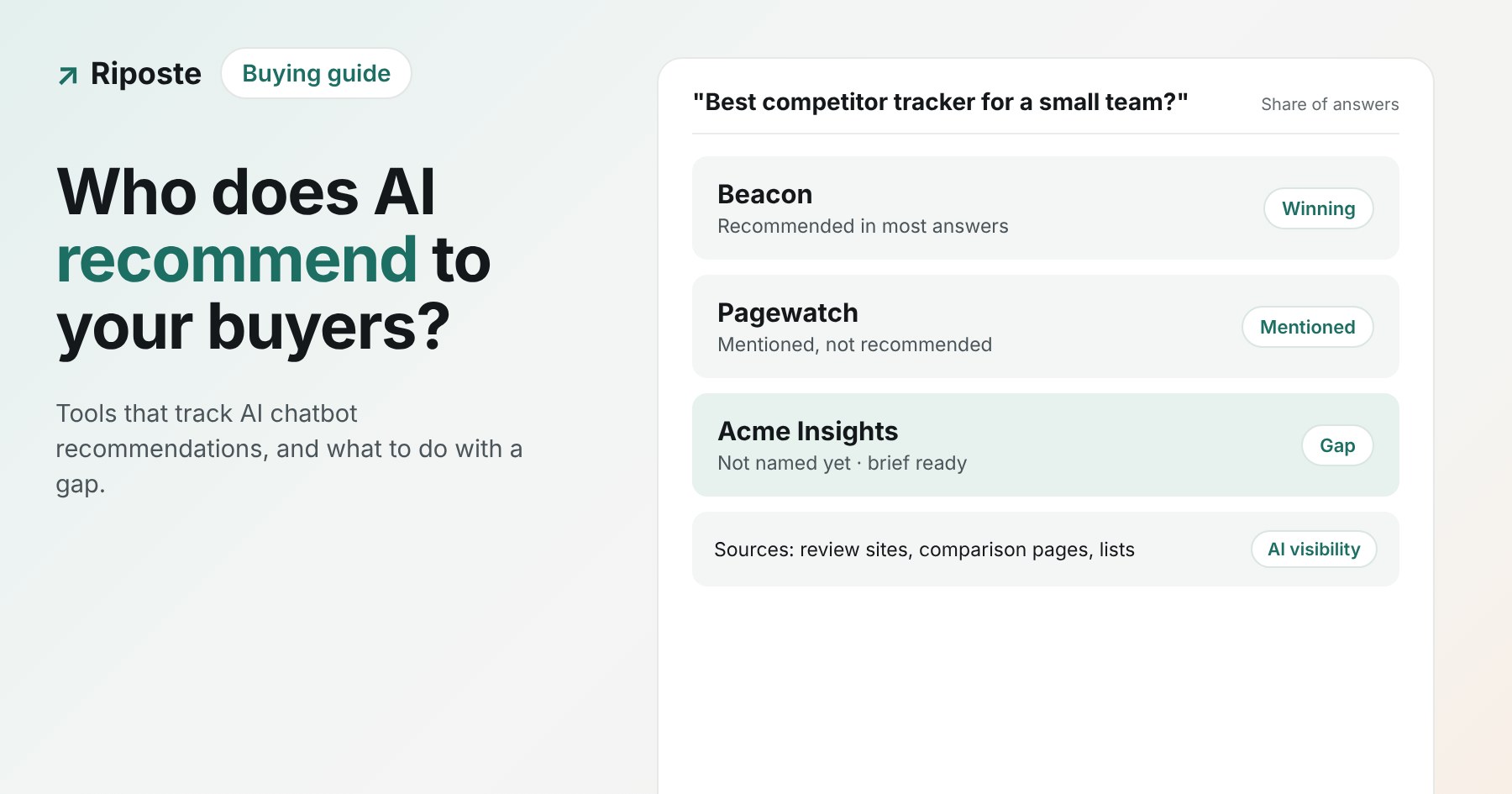
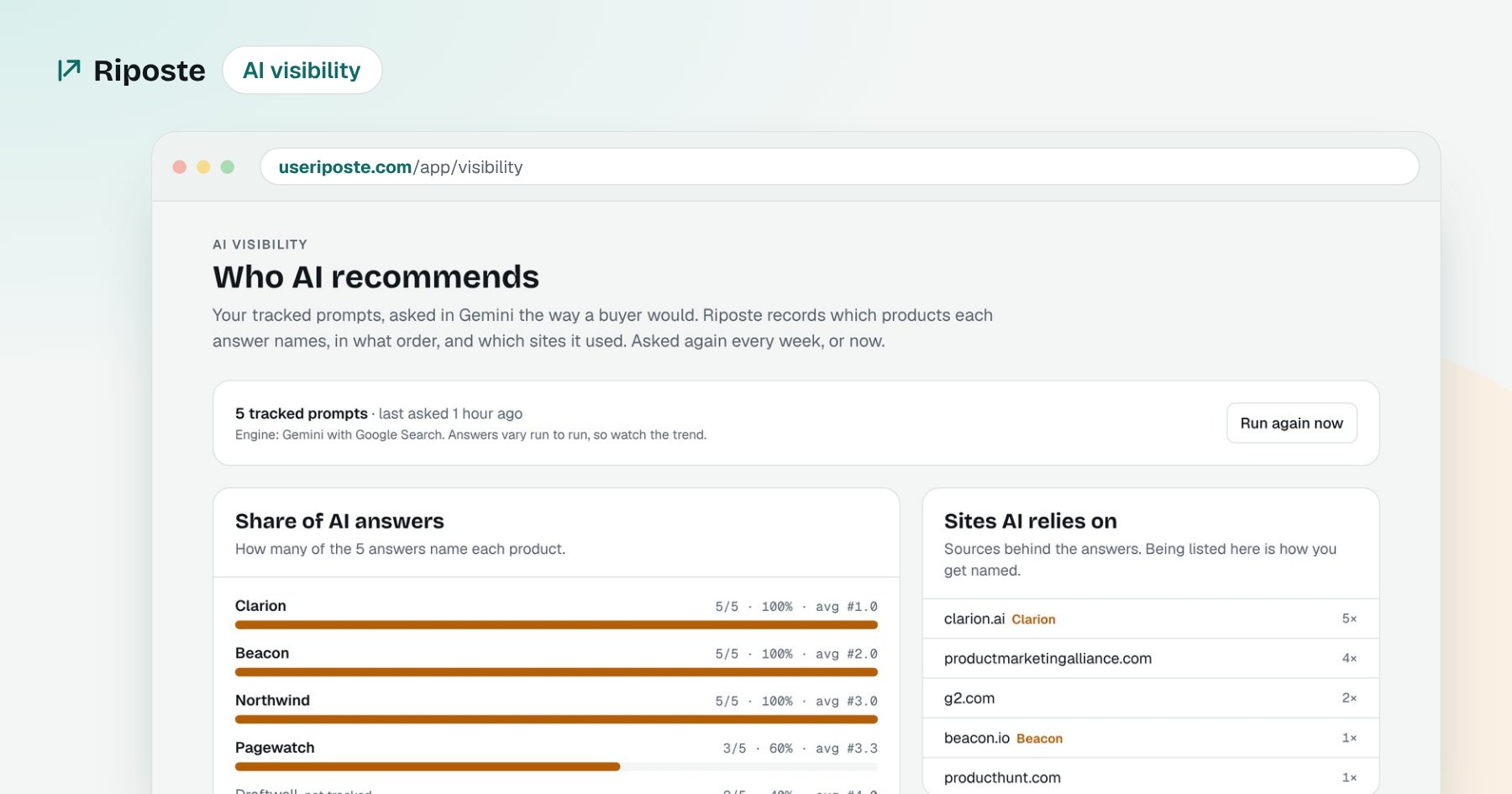
Ask each question and write down three things: which products the answer names, in what order, and which sites it cites. That's your baseline.
You can do this by hand, or run the free AI recommendation checker, which asks 3 buyer questions about your product in Gemini with Google Search. If you want to compare dedicated tools that cover more AI engines, I've reviewed them in software to track AI chatbot recommendations.
Here's what a baseline can look like. The companies are made up:
| Buyer question | Who's named, and sites cited |
|---|---|
| Best competitor tracker for a small team | Acme Insights, Beacon, Pagewatch. Cited: a review site, a listicle, Acme's blog |
| Pagewatch alternatives for startups | Beacon, Acme Insights. Cited: a directory, Beacon's comparison page |
| Track competitor pricing automatically | Pagewatch. Cited: Pagewatch's guide, a forum thread |
In this example, the product you'd be checking is named zero times out of three. The sites cited tell you where to start.
3. Make sure AI can reach and read your pages
This is the boring step, and it's easy to get wrong without noticing.
- Let the search crawlers in. Allow Googlebot in your robots.txt, OAI-SearchBot for ChatGPT search and Claude-SearchBot for Claude. Google also says to check your CDN or hosting doesn't block crawlers.
- Make sure the page is indexed. Use URL Inspection in Search Console. A page that isn't indexed can't be a supporting link in Google's AI features.
- Keep important content in text. Google lists this as a best practice. A pricing table inside an image doesn't help.
- Link to the page from your other pages. Google recommends internal links so content is easy to find.
What you don't need, according to Google: special AI text files, new machine-readable files, or extra schema markup. I do keep an llms.txt file on useriposte.com, but I don't count on it for Google, because Google says it isn't needed.
4. Publish pages that answer buying questions directly
AI answers quote pages that answer the question clearly. For B2B software, three page types matter most:
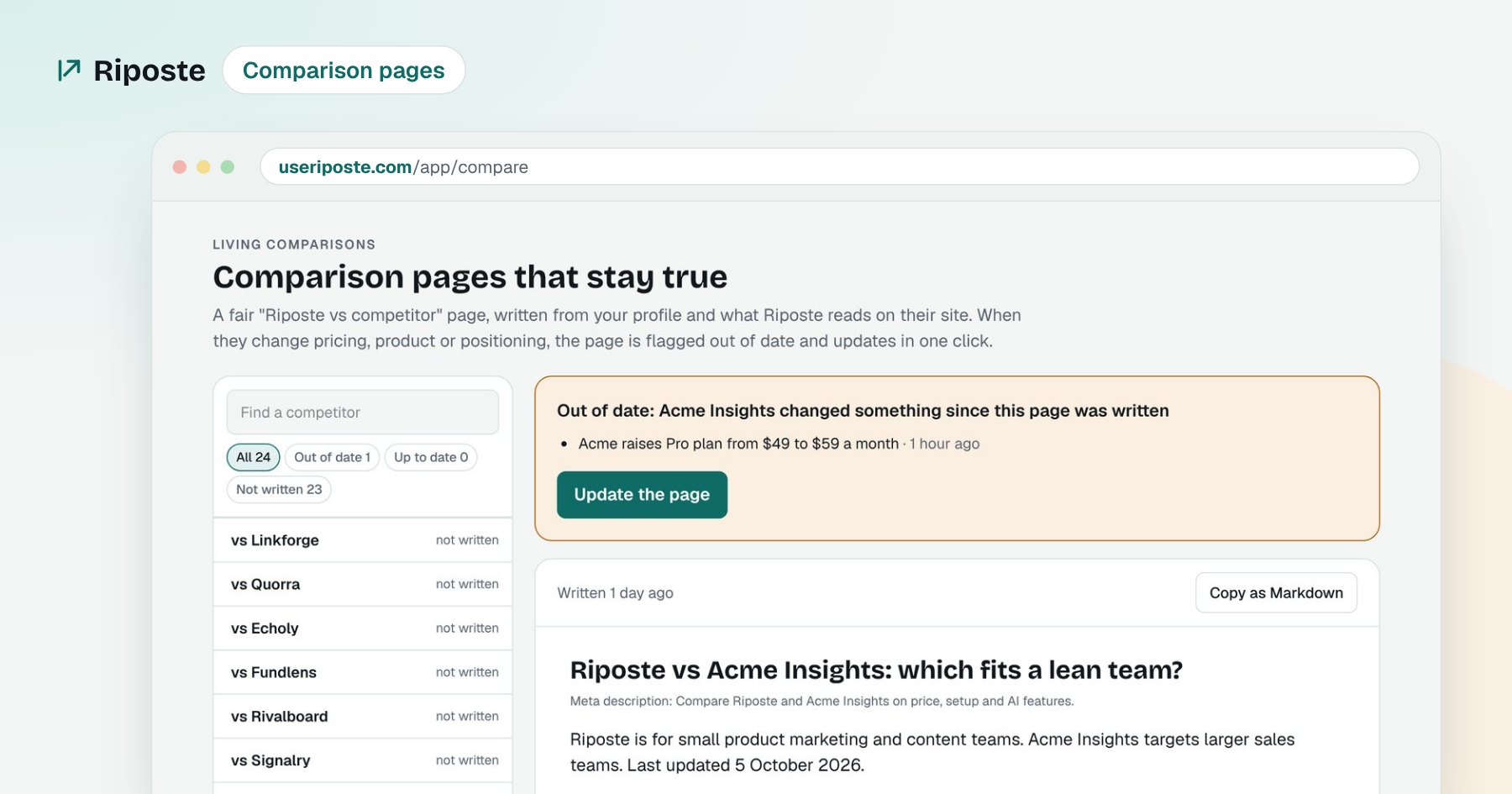
- Comparison and alternatives pages. Buyers ask AI to compare tools and suggest alternatives, and these pages answer exactly that. Keep them fair and dated. I wrote about how I keep mine accurate in living comparison pages.
- "Best tool for…" guides for each situation you serve, such as a team size, an industry or a budget.
- How-to guides for the job your product does, written by someone who has done it.
On every page, put a direct answer in the first few lines, then the detail. Add an FAQ section with the follow-up questions buyers ask. And write from real experience, because Google's own helpful content guidance asks whether content shows "first-hand expertise and a depth of knowledge".
5. Get mentioned on the sites the answers cite
Go back to the sites cited in step 2. For each site, ask whether you can honestly be on it:
- Directories and review sites: list your product, with the same accurate description everywhere.
- Listicles and guides by others: reach out to the author when your product truly fits their list.
- Communities: answer questions where buyers ask them, helpfully and without spamming links.
This is slower than publishing on your own site, but if an answer keeps citing the same sites, being on them is how you get into that answer.
6. Keep your facts accurate and dated
If your pricing page, feature list and comparison pages disagree, an AI answer can pick up the wrong one. Keep one source of truth, date the facts that change, and update your listings when your product changes.
This goes for what you say about competitors too. Every claim on my comparison pages comes from the competitor's own site, with the date I checked it.
7. Recheck every week and track the trend
Ask the same questions every week and watch three numbers: how often you're named, your position, and whether the cited sites now include you. Google also counts traffic from AI Overviews and AI Mode in Search Console, inside the Performance report under the "Web" search type.
What doesn't help
- Special AI files or markup for Google. Google says none is needed.
- Lots of thin pages written for AI. Google's guidance asks whether content was created "primarily to help people". Pages made only to be picked up by AI are the opposite.
- Stuffing your brand into answers you write elsewhere. Communities notice, and it doesn't make your product a better answer.
- Judging from one answer. Answers change. Look at the trend.
Where Riposte fits, and where it doesn't
Riposte's AI visibility asks your buyers' questions in Gemini with Google Search every week. It records which products each answer names, in what order, and which sites it cited. When a competitor is named and you aren't, the gap can become a content brief.
It only checks Gemini. If you need ChatGPT, Claude, Perplexity and other AI engines, a dedicated AI visibility tool is the better pick.
Want a quick first look?
The free AI recommendation checker asks 3 buyer questions about your product in Gemini with Google Search, and shows who gets recommended and which sites the answers relied on. No sign-up needed.
Guides in this topic
- Software to track AI chatbot recommendations: the tools that track ChatGPT, Gemini and more, compared.
- How Riposte shows who AI recommends: buying questions in Gemini, every week, with the gaps turned into briefs.
- Free AI recommendation checker: a quick first look, no sign-up.
How I wrote this
I'm a product marketer, and I build Riposte, so I have a stake in this topic. The lessons in "What I learned" come from building and testing the checker. Every claim about how Google, Gemini, ChatGPT and Claude work comes from their own documentation, opened on 17 November 2026 and listed below. I use AI to help me draft, and I check every fact myself before it goes out.
Sources
- Google Search Central: AI features and your website, checked 17 November 2026
- Google Search Central: Creating helpful, reliable, people-first content, checked 17 November 2026
- Gemini API: Grounding with Google Search, checked 17 November 2026
- OpenAI: Overview of OpenAI crawlers, checked 17 November 2026
- Anthropic: Does Anthropic crawl data from the web?, checked 17 November 2026
The bottom line
AI assistants recommend the products they can find and read about on pages they trust. Ask your buyers' questions, see who gets named and why, and close one gap at a time.
Frequently asked questions
How do I get cited by ChatGPT?
Let ChatGPT's search crawler, OAI-SearchBot, reach your site, publish pages that answer your buyers' questions directly, and get mentioned on the sites its answers cite. OpenAI says sites that block OAI-SearchBot won't be shown in ChatGPT search answers.
How do I get my product into Google's AI Overviews?
Your page has to be indexed and eligible to show in Google Search with a snippet. Google says there are no extra requirements or special optimizations beyond that, so the work is good SEO plus pages that answer the question clearly.
Do I need llms.txt or special schema to show up in AI answers?
Not for Google. Google says you don't need AI text files, new machine-readable files or special schema.org markup to appear in AI Overviews or AI Mode. Structured data should still match what's visible on the page.
Why does AI recommend my competitor and not me?
Usually because the pages the AI found when it searched, or learned from, mention your competitor and not you. Check which sites the answer cites: if your competitor is on those sites and you aren't, that's the gap to close.
Does SEO still matter for AI search?
Yes. Google's guidance for its AI features is the same SEO basics: let Google crawl your pages, use internal links, keep important content in text and give people a good page experience. AI answers that search the web still need to find your pages.
How do I check if AI recommends my product?
Ask the AI the questions your buyers ask, without your brand name, and note which products it names, in what order, and which sites it cites. The free AI recommendation checker does this in Gemini with Google Search.
How long does it take to show up in AI answers?
There's no fixed time. Google says changes can take days to months to be recrawled, and OpenAI says robots.txt changes take about 24 hours to reach its systems. After that, it depends on whether your pages answer the question better than what's already cited.
Should I block AI crawlers from my site?
Block training bots if you don't want your pages used to train models, but think twice before blocking search bots. OpenAI's GPTBot is for training, while OAI-SearchBot decides whether you can appear in ChatGPT search answers.
Do comparison pages help you get recommended by AI?
They can, because buyers often ask AI to compare tools or suggest alternatives. A fair, dated comparison page answers that question directly, which gives an AI answer something specific to cite.
How do I get my site cited by Claude?
Allow Anthropic's Claude-SearchBot in your robots.txt, then publish pages that answer your buyers' questions directly. Anthropic says blocking Claude-SearchBot stops your content being indexed for search and may reduce your site's visibility in Claude's search results.