Saniya Gazala
In short
Software that tracks AI chatbot recommendations asks AI assistants the questions your buyers ask, records whether your product or a competitor gets recommended, and shows which sites the answers relied on. If you need many AI engines and detailed prompt analytics, pick a standalone AI visibility tool like Peec AI, Otterly.ai, ZipTie.ai, Profound or Semrush's AI Visibility Toolkit. If you want the findings turned into content briefs next to your competitor tracking, a competitive intelligence tool like Riposte fits, though it only checks Gemini.
On this page
- 01How AI chatbot tracking software works for B2B marketers
- 02Core features to look for in an AI recommendation tracker
- 03Top standalone AI visibility and citation tracking platforms
- 04Turning AI visibility into action: the competitive intelligence approach
- 05How to choose the right tool for your team
- 06Wrapping up
- 07Sources
- ✓The bottom line
- ?Frequently asked questions
Some buyers now ask an AI assistant "what's the best tool for…" before they visit any vendor's website. For a product marketer, that raises a new question: when they ask, does the answer name us, or a competitor?
Software that tracks AI chatbot recommendations answers that question. This guide covers how these tools work, what to look for, and six options: five standalone AI visibility tools and one competitive intelligence tool. I checked each one on its own website on 27 October 2026. I build one of them, Riposte, and I'll be clear about where the others are stronger.
How AI chatbot tracking software works for B2B marketers
Every tool in this guide does some version of three things:
- Asks the questions buyers ask. You give it prompts like "best competitor tracking tool for a small marketing team", and it asks them in one or more AI assistants, usually on a schedule.
- Records what the answer says. Which brands are named, in what order, and whether your product is actually recommended or just mentioned.
- Shows the sources. When an assistant searches the web, the answer relies on pages: review sites, comparison pages, lists, vendor pages. Knowing them tells you where to show up.
It helps to keep three outcomes apart:
- A mention: the answer names your brand.
- A recommendation: the answer suggests your product as a good choice for the question.
- A cited source: one of your pages is used as a source, even if your brand isn't recommended.
A tool that only counts mentions can make you look better than you are. The recommendation is what moves a buyer.
Core features to look for in an AI recommendation tracker
- Which AI engines it covers. Gemini, ChatGPT, Perplexity, Google AI Overviews and AI Mode, Microsoft Copilot, Claude. Your buyers may use more than one.
- Prompt-level results. Not just a score, but each answer, so you can see why an assistant picked a competitor.
- Sources behind each answer. The sites to get listed on, and the pages to improve.
- Competitor comparison. Your share of answers next to each competitor's.
- A trend over time. AI answers change from run to run, so one result means little.
- A path to action. Does it help you respond, for example with a content brief, or stop at the report?
Top standalone AI visibility and citation tracking platforms
These tools are built for AI visibility first, and they're the better pick if you need several AI engines.
| Tool | AI engines covered | Strongest at | Price (checked 27 Oct 2026) |
|---|---|---|---|
| Peec AI | Choose 3: ChatGPT, AI Mode, AI Overviews, Copilot, Gemini, Naver AI; up to 13 on Enterprise | Daily prompt tracking, unlimited users | Not shown on its pricing page; free trial |
| Otterly.ai | ChatGPT, AI Overviews, Perplexity, Copilot; Gemini, AI Mode, Claude as add-ons | Simple monitoring from a low starting price | From $29 a month; free trial |
| ZipTie.ai | ChatGPT, AI Overviews, Perplexity, AI Mode, Copilot, Bing AI Overview, Gemini | Mentions, citations and the sources behind each answer | Usage-based, about a cent per engine check; 7-day trial |
| Profound | ChatGPT, Perplexity, Claude, Gemini, AI Overviews, Copilot, Grok, DeepSeek | Prompt volumes, citation analysis, content agents | Not shown on its features page; trial with 50 prompts |
| Semrush AI Visibility Toolkit | ChatGPT, Google AI Mode | Fits into the Semrush SEO toolset | $99 a month; no free trial |
Engines and prices from each vendor's own site, checked 27 October 2026. Plans change often, so check before you buy.
Peec AI
Peec AI is AI search analytics for marketing teams and agencies. Its plans track prompts daily across three models you choose from ChatGPT, Google AI Mode, AI Overviews, Microsoft Copilot, Gemini and Naver AI, with more models as add-ons and up to 13 on Enterprise. All plans include unlimited users.
Good fit if several people need access and you want daily tracking across a few engines.
Otterly.ai
Otterly.ai monitors ChatGPT, Google AI Overviews, Perplexity and Microsoft Copilot on every plan, with Gemini, Google AI Mode and Claude as add-ons. Plans start at $29 a month for 15 prompts.
Good fit if you want to start small and cheap, with Perplexity included.
ZipTie.ai
ZipTie.ai covers seven engines, including Gemini, ChatGPT, Perplexity and Bing's AI answers. It separates mentions (your brand named in the answer) from citations (your page used as a source), tracks sentiment on mentions, and keeps the sources behind each answer, including Reddit threads and YouTube videos. Pricing is usage-based, at about a cent per engine check.
Good fit if you care most about sources and citations across many engines.
Profound
Profound covers eight engines, including ChatGPT, Perplexity, Claude and Gemini, and says it draws insights from the consumer experience, not API outputs. It adds prompt volumes, which show what people actually ask AI platforms, citation analysis, and agents that research and write content. It says it's built for enterprise teams.
Good fit if you're an enterprise team that wants AI visibility, demand data and content workflows in one place.
Semrush AI Visibility Toolkit
Semrush's AI Visibility Toolkit covers ChatGPT and Google AI Mode, with brand performance (share of voice and sentiment), prompt research, prompt tracking and competitor research. It costs $99 a month and has no free trial.
Good fit if your team already lives in Semrush and wants AI visibility next to its SEO data.
Turning AI visibility into action: the competitive intelligence approach
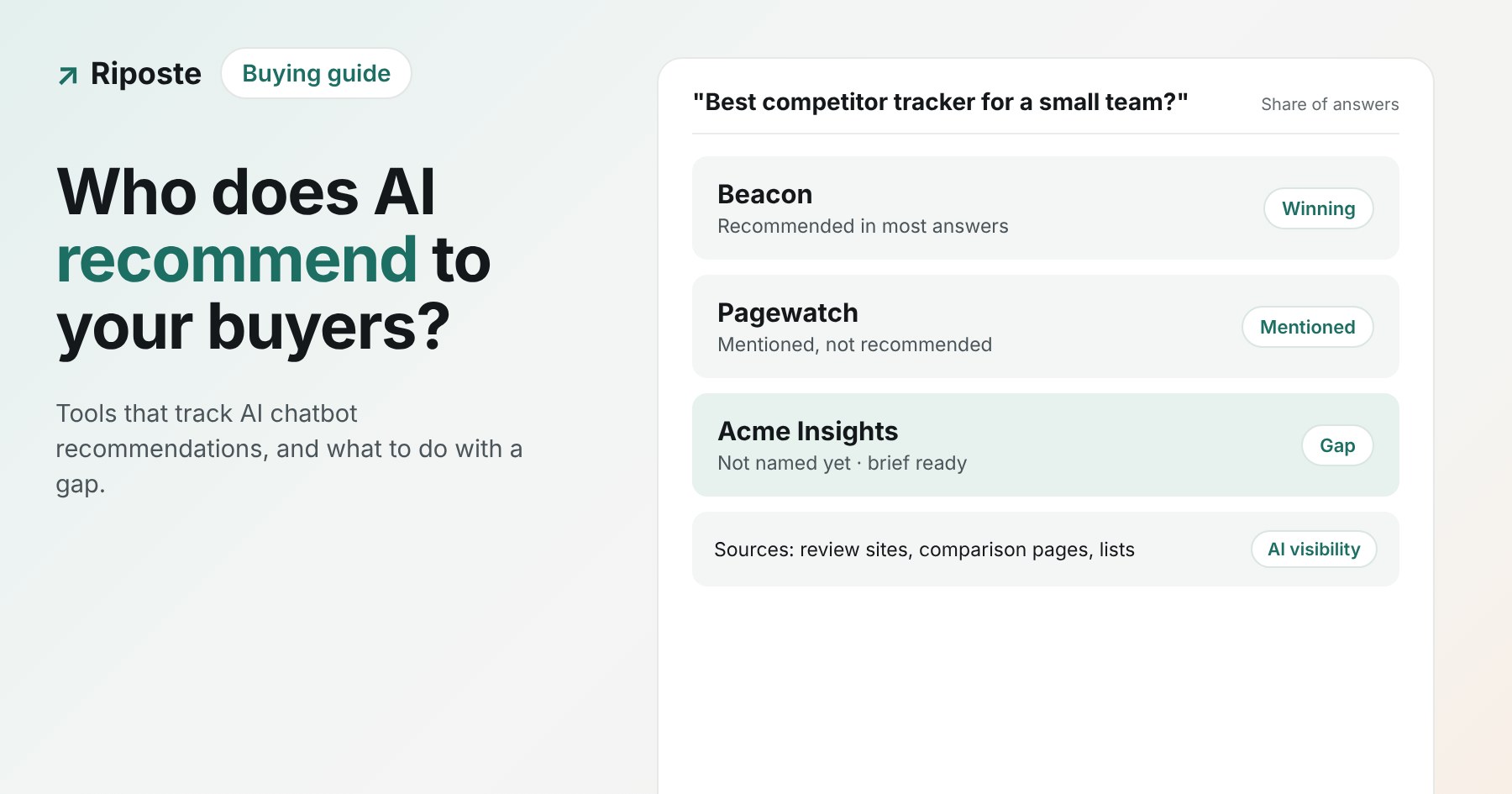
A visibility report tells you that a competitor is recommended and you aren't. For a product marketer, that's the start of the work. You still have to work out why, and decide what to change.
That's the gap Riposte tries to close. It's a competitive intelligence tool, so AI visibility sits next to daily tracking of your competitors' websites, blogs and pricing pages:
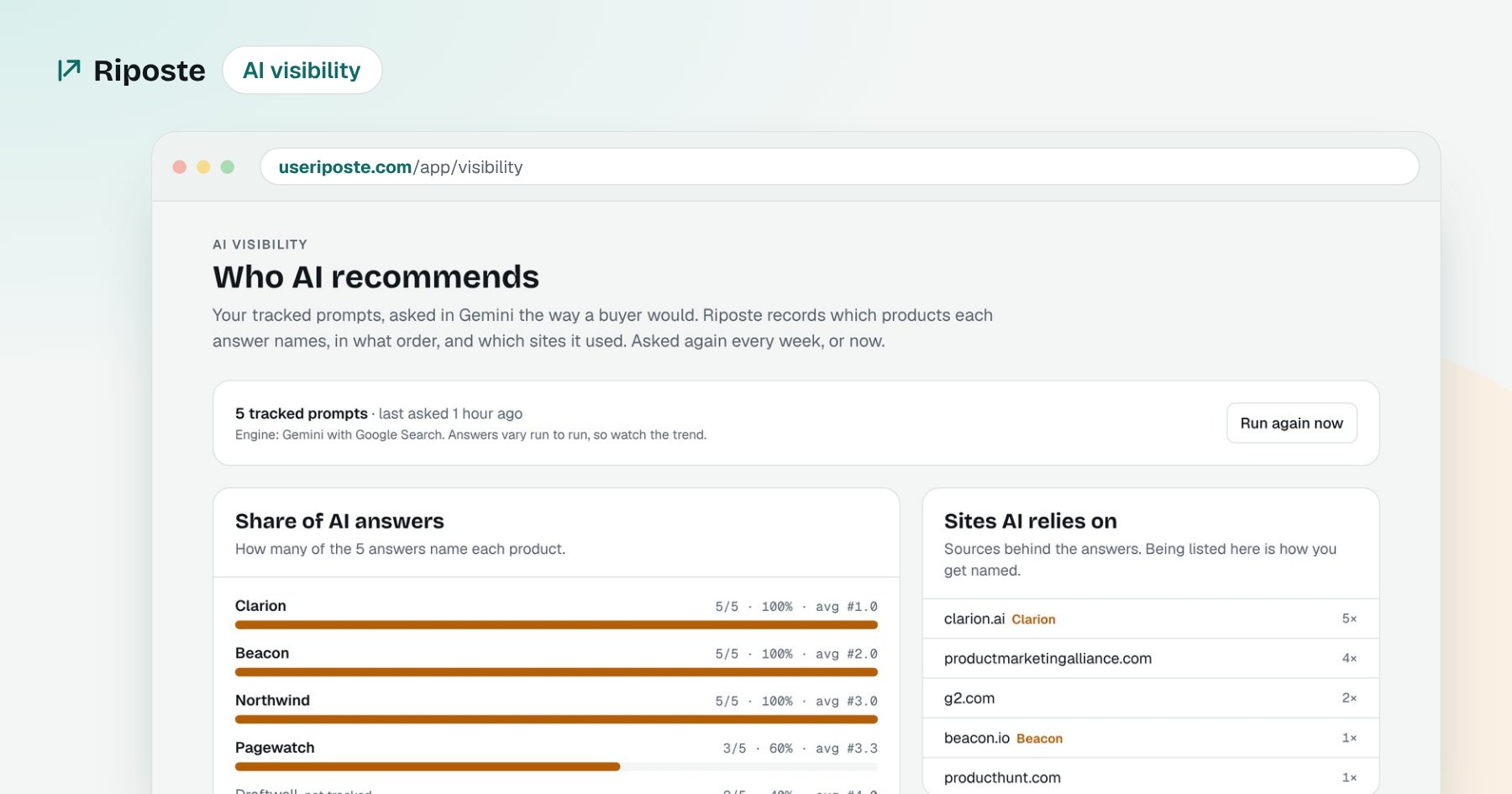
- It asks your buyers' questions in Gemini with Google Search, every week, and records the products named, the sites the answers relied on and your share next to competitors.
- For each gap, "Why are they winning?" shows what the answer says the winner is known for and which sites it leaned on, and, for competitors you track, what they changed on their own site recently.
- One click turns the gap into a content brief, with a keyword, angle, outline and FAQs, and the prompt shows the brief's status from then on.
- Competitor changes become action kits. When a competitor changes its site, Riposte drafts the response, like a battlecard update or a comparison page change.
I've explained how it works in detail in how Riposte shows who AI recommends.
Its limits, plainly: Riposte checks Gemini only, with Google Search. It doesn't cover ChatGPT, Perplexity or other engines, and multi-engine coverage is where the standalone tools are stronger. During the beta it tracks up to 10 prompts and up to 5 competitors.
How to choose the right tool for your team
SEO and content teams that need many AI engines and detailed attribution should start with a standalone tool. Profound and ZipTie.ai cover the most engines on their standard offers, Peec AI's Enterprise plan goes up to 13 models and every plan includes unlimited users, Otterly.ai is the cheapest way to start, and Semrush fits if you already use it.
Small product marketing teams of 1 to 5 people who also track competitors may get more from a tool that connects AI visibility to competitor changes and drafts the next step. That's where Riposte fits, if Gemini coverage is enough for now.
The trade-off is breadth versus depth. A standalone tool tells you how you show up across many AI assistants. A competitive intelligence tool covers fewer engines but ties each gap to what competitors changed and what to write next. Some teams use both: a standalone tool for coverage, and a CI tool for the response.
Whichever you choose, compare tools on your own buyer questions. Every vendor's sample report looks good. Your own prompts show what you'd actually learn.
Want a quick first look?
The free AI recommendation checker asks 3 buyer questions about your product in Gemini with Google Search, and shows who gets recommended and which sites the answers relied on. It's free, needs no sign-up, and you can run 2 checks a day.
To compare competitor tracking tools more broadly, see the compare hub.
Wrapping up
Software to track AI chatbot recommendations shows whether AI assistants recommend you or a competitor, and which sources drive the answer. Standalone AI visibility tools are the right choice when you need many engines and detailed attribution. If you're a small product marketing team, the more useful question may be what you do next, and a tool that turns each gap into a content brief can help.
You can join the free Riposte beta at useriposte.com to see who Gemini recommends for your buyers' questions.
Sources
- Peec AI pricing, checked 27 October 2026
- Otterly.ai pricing, checked 27 October 2026
- ZipTie.ai homepage, checked 27 October 2026
- Profound features, checked 27 October 2026
- Semrush AI Visibility Toolkit, checked 27 October 2026
The bottom line
If you need many AI engines and detailed attribution, choose a standalone AI visibility tool. If you're a small product marketing team that wants each gap turned into a content brief next to your competitor tracking, a CI tool like Riposte fits, with Gemini only.
Frequently asked questions
What is the best software to track AI chatbot recommendations?
It depends on how many AI engines you need. Standalone tools like Peec AI, Otterly.ai, ZipTie.ai and Profound cover several engines, including ChatGPT, Perplexity and Google's AI answers. Riposte checks only Gemini, but turns each gap into a content brief next to your competitor tracking.
How do AI chatbots decide which software to recommend to buyers?
When they search the web, AI assistants build answers from the pages they find, such as review sites, comparison pages, lists and vendor sites. That's why tracking tools show which sources an answer relied on: those are the pages to improve or get listed on.
Can software track recommendations across both Google Gemini and ChatGPT?
Yes. As of 27 October 2026, ZipTie.ai and Profound list both among the engines they cover, Peec AI lets you choose both among its three models, and Otterly.ai offers Gemini as an add-on to its ChatGPT tracking. Riposte checks Gemini only.
What is the difference between an AI brand mention and an AI recommendation?
A mention means the answer names your brand. A recommendation means the answer suggests your product as a good choice for the question. A cited source is different again: your page is used as a source, even if your brand isn't recommended.
What should a product marketer do when an AI chatbot recommends a competitor?
Look at why: what the answer says the competitor is known for, and which sites it relied on. Then fix the gap, for example with a clearer page that answers the buyer's question, a fair comparison page, or getting listed on the sites the answer cites.
Which AI visibility tool covers the most AI engines?
Of the tools in this guide, Profound lists eight engines and ZipTie.ai seven on their own sites, as of 27 October 2026. Peec AI's Enterprise plan offers up to 13 models.
How much does AI visibility tracking software cost?
As of 27 October 2026, Otterly.ai starts at $29 a month, Semrush's AI Visibility Toolkit costs $99 a month, and ZipTie.ai charges about a cent per engine check. Peec AI and Profound don't show prices on the pages I checked, and Riposte is free during its beta.
Does Riposte track ChatGPT or Perplexity?
No. Riposte asks your buyers' questions in Gemini with Google Search only. If you need ChatGPT, Perplexity or other engines, a standalone AI visibility tool is the better choice.
What is generative engine optimization?
Generative engine optimization, or GEO, means improving how your brand shows up in answers from AI assistants. It's also called answer engine optimization (AEO). It overlaps with SEO, because many AI answers rely on pages found through search.
How often should I check AI recommendations?
Weekly is a good rhythm for most teams. AI answers change from run to run, so look at the trend over several weeks rather than a single result.