Saniya Gazala
In short
I passed Profound University's Marketing Engineering certification with 90%. For the project, I took a workflow from my last product marketing role, tracking competitors by hand, and rebuilt it as Riposte, which checks competitor pages every morning and drafts the response. The biggest lesson came from the one area where I scored 2 out of 3: split every step into the parts a fixed rule can do and the parts that need my judgment, then automate only the rules.
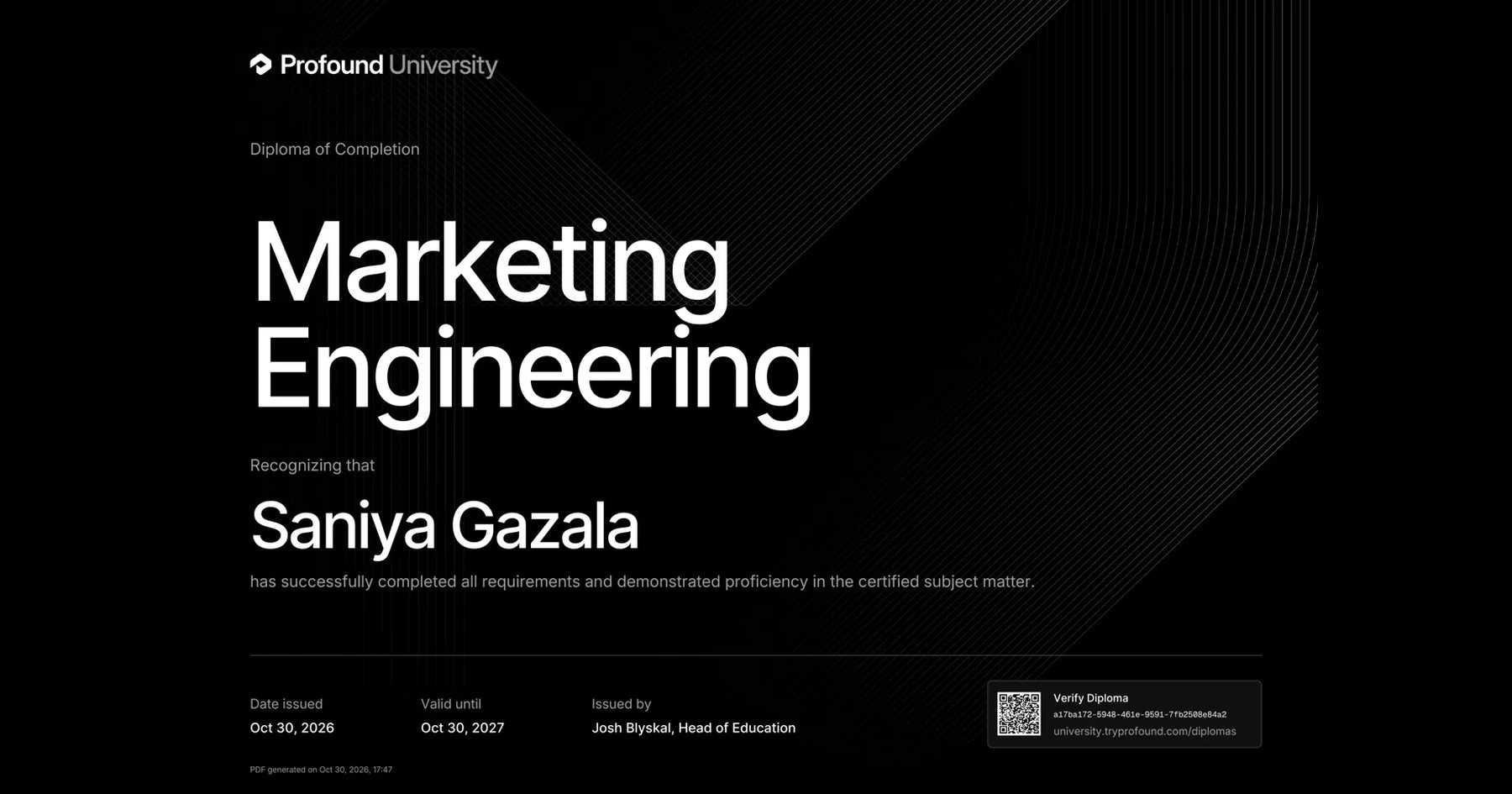
I'm now a certified Marketing Engineer. I passed Profound University's Marketing Engineering certification with 90%, and my project was Riposte, the competitor tracking tool I build. The most useful part wasn't the score. It was the one place I lost a point, because it changed how I build.
You can verify my diploma here. It was issued on 30 October 2026 and is valid until 30 October 2027.
What the certification asks you to do
The Marketing Engineering course is on Profound University. Its pitch is simple: every major business function built an engineering layer, and marketing is next.
The project is practical. You pick a real workflow from your job, break it apart, build it as far as you can, and present it in 5 to 15 minutes. A reviewer scores it. Mine was Tom Stachowiak from Profound University.
Why I picked competitor tracking
In my last product marketing role, competitor tracking was the job that never fit in the week. Every Monday I exported each competitor's pages from an SEO tool, compared them with last week's sheet, and pasted what was new.
It had four problems:
- It was repetitive. The same exports, every Monday, for every competitor.
- It was inconsistent. It was easy to miss a change, and a missed pricing change means sales says the wrong thing on a call.
- It was reactive. We often found out about a competitor's move too late.
- It took time from the real work: positioning, launches and helping sales win.
Tom picked up on this: "You gave four concrete, different reasons for tackling this workflow (repetitive, inconsistent with a real accuracy risk, reactive, and a direct cost to your actual PMM work), which is much stronger than a generic 'it's time consuming.'"
What I built: Riposte
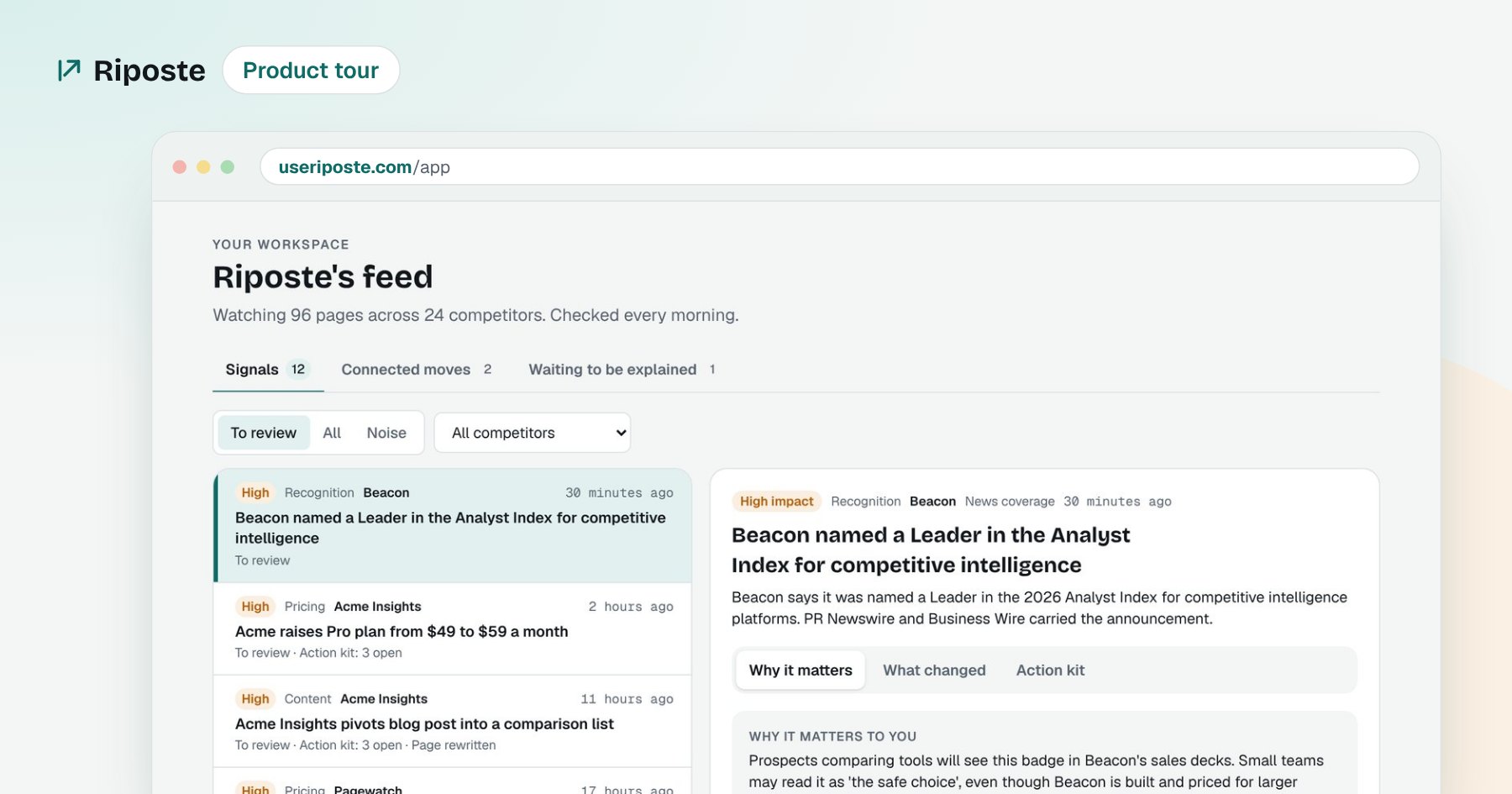
Riposte does that Monday job every morning, without me.
- It reads each competitor's pricing page, blog, release notes and sitemap.
- It compares each page with the last version and drops noise like menus, dates and cookie banners.
- It explains why a change matters for my product.
- It drafts an action kit: what to do, who owns it and a first draft.
In my demo I closed with one line: sales gets its talk track, content gets its topic, my manager gets a Monday summary. Tom called it "a genuinely good stakeholder explanation: no jargon, all outcome."
If you want the full tour, I've written up what Riposte does, page by page.
My scorecard
| Area | Score |
|---|---|
| Problem identification and prioritization | Excellent (3/3) |
| Decomposition and systems thinking | Meets expectations (2/3) |
| Depth path (agent demo) | Excellent (3/3) |
| Presentation and stakeholder communication | Excellent (3/3) |
A few things Tom wrote that I'll keep:
- On a hidden assumption I caught: "The best moment here is catching that you were treating a recurring page in your export as 'probably optimized' when that was really an unverified assumption, not a fact, that's a real hidden judgment call."
- On the demo: "This demo is specific to your actual workflow in a way that's easy to see."
- And at the end: "Well done. You put in the work, and it shows."
The 2 out of 3 came with clear feedback. He asked me to "break 'compare' and 'identify what changed' into the sub-operations they actually involve, and explicitly separate which parts are a fixed rule versus which require your judgment."
The 2/3, put into practice
So I did that for the whole workflow. A rule gives the same right answer every time, so Riposte does it alone. A judgment call depends on context, so AI drafts it and I decide.
| Step | Rule or judgment |
|---|---|
| Find each competitor's pages | Rule. Found automatically, I confirm |
| Fetch the pages every morning | Rule. Riposte |
| Strip menus, dates, cookie banners | Rule. Riposte |
| Compare with yesterday | Rule. Riposte |
| Is this change meaningful? | Judgment. AI drafts a call, I decide |
| Why it matters for my product | Judgment. AI drafts, I check |
| What to do and who owns it | Judgment. AI drafts the action kit, I decide |
| Anything that goes public | Judgment. Only after I check the source and mark it reviewed |
Writing it down like this made one thing obvious. The first four steps are where the hours went, and they're safe to automate. The last four are where mistakes get expensive, so that's where I stay involved.
A real example of why judgment matters
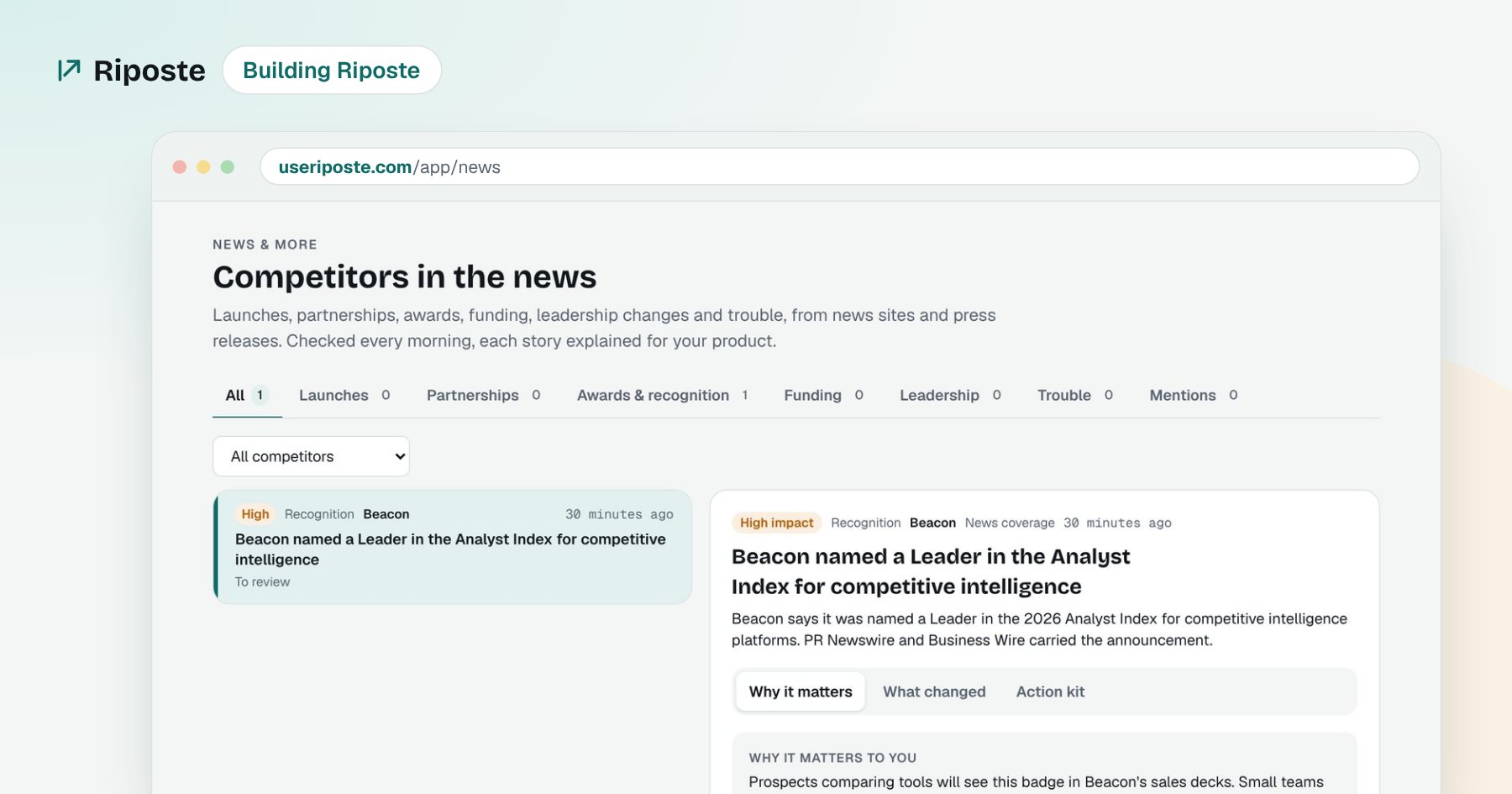
This week Riposte flagged a high-impact change: Visualping had added "a $3,000/yr plan with custom AI prompt filtering".
It sounded right, and it would have been easy to pass on. When I checked Visualping's own pricing page, it was half right. The $3,000 a year plan exists, but custom AI prompts are on its Solutions plan, not that one.
So I dismissed that signal and updated our Visualping comparison page with the facts I'd checked, dated. If I'd let the AI's summary go straight to a public page, I'd have published something wrong about another company.
The lesson
Automate the rules, protect the judgment.
What I'm changing next
- Every step gets split into its sub-steps, and each sub-step is marked rule or judgment. "Compare" alone hides several: clean the page, match sections, measure what changed, and decide if it's worth a look. Only the first three are rules.
- Only updates I've reviewed appear on our comparison pages. This one is already live: the "Latest updates" section on each comparison page only shows changes I've checked and marked reviewed.
Thank you
Thank you to Tom Stachowiak for such a detailed review and kind words. The feedback on my weakest area was the most useful part of the whole course. And thank you to Josh Blyskal, Head of Education at Profound, for a practical course that's easy to follow.
I shared the news here on LinkedIn.
Try it
If you track competitors by hand today, you can join Riposte's free, invite-only beta. It's built for teams of 1 to 5 marketers.
Does AI recommend you?
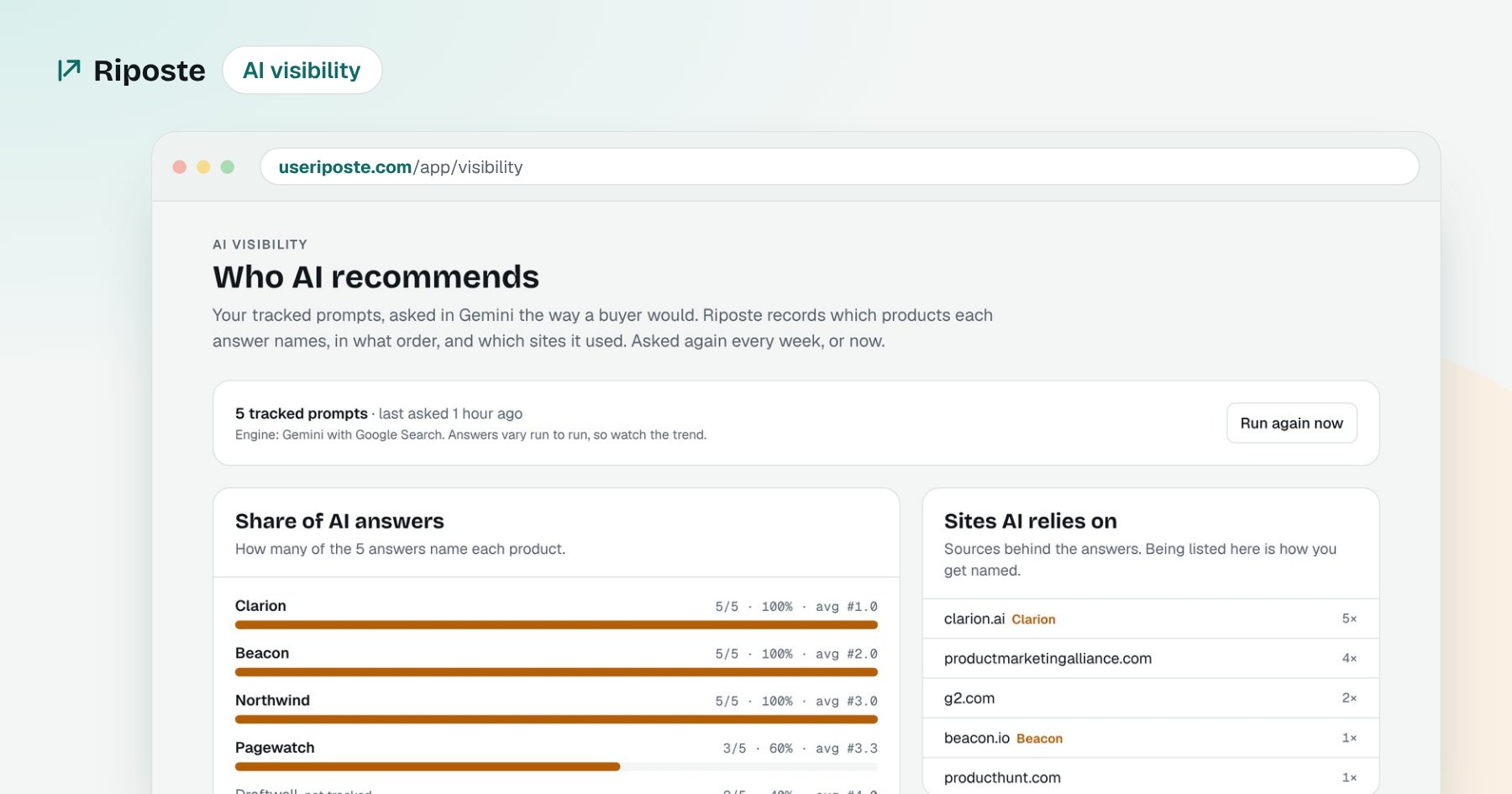
The free AI recommendation checker asks 3 buyer questions about your product in Gemini with Google Search, and shows who gets recommended and which sites the answers relied on. No sign-up needed. To track this every week, see how Riposte tracks AI visibility.
The bottom line
Automate the rules, protect the judgment. The certification taught me to look at every step of a workflow and ask which kind it is before I let AI near it.
Frequently asked questions
What is Profound's Marketing Engineering certification?
It's a certification from Profound University, Profound's education site. You take the Marketing Engineering course, pick a real workflow from your job, break it apart, build it as far as you can, and present it in 5 to 15 minutes. A reviewer then scores the project.
What is a marketing engineer?
A marketing engineer is a marketer who builds the systems behind marketing work, instead of doing the same steps by hand every week. Profound University puts it this way: every major business function built an engineering layer, and marketing is next.
What's the difference between a rule and a judgment call in an AI workflow?
A rule gives the same right answer every time, like fetching a page or comparing it with yesterday's copy, so it can be fully automated. A judgment call depends on context, like whether a change matters for your product, so AI can draft it but a person should decide.
How do you pass the Marketing Engineering certification?
Pick a workflow you actually do, show why it's worth fixing with concrete reasons, break it into steps, and demo something that works on your real data. My reviewer valued specific reasons and a demo tied to my own workflow over general claims.
Which workflow should I pick for a marketing engineering project?
Pick one you repeat every week, that's easy to get wrong, and that takes time from more important work. Competitor tracking fit all three for me.
Can AI decide which competitor changes matter?
AI can draft that call and explain its reasoning, which saves a lot of time. But it can be partly wrong, so a person should check the source before anything reaches sales, leadership or a public page.