Saniya Gazala
In short
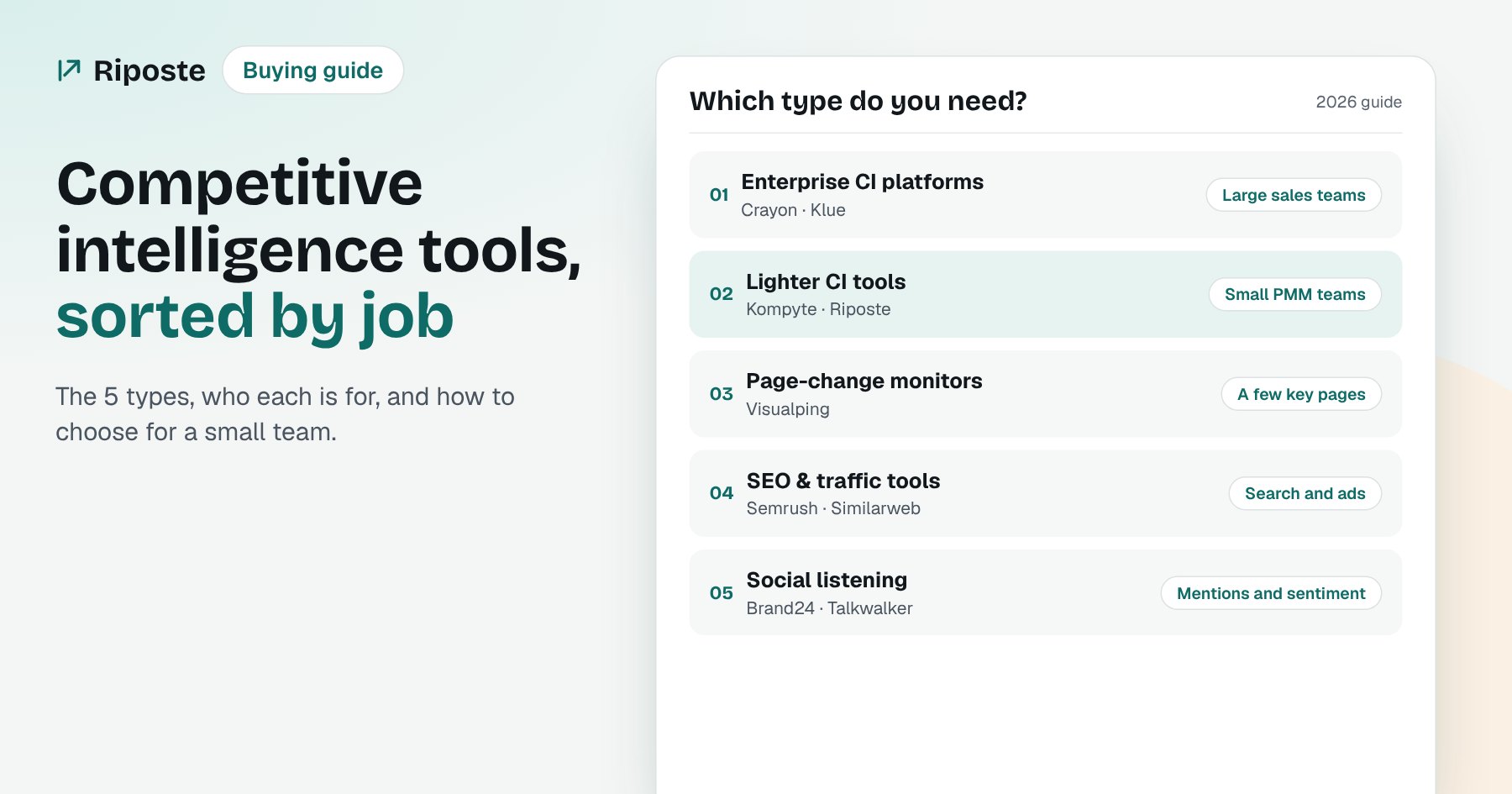
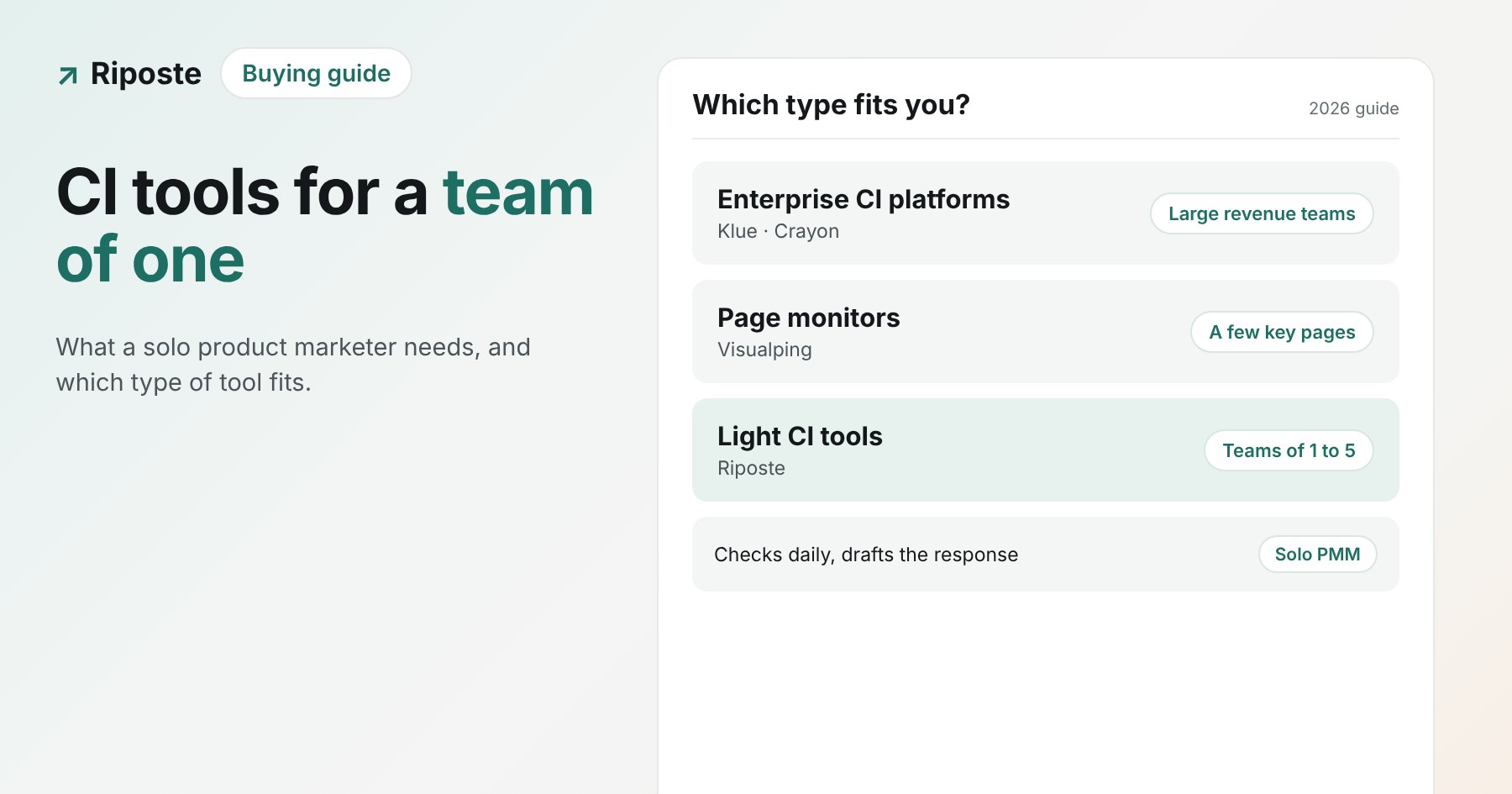
The best competitive intelligence tool for a solo product marketer does the checking for you and helps you respond, without a program to run. Enterprise platforms like Klue and Crayon are built for revenue teams with a CI owner, and page monitors like Visualping summarize changes on pages you pick but leave the response to you. A lighter tool such as Riposte checks pricing pages, release notes and blogs every morning, filters noise, explains each change for your product and drafts the response.
On this page
- 01Why enterprise CI platforms are a lot for one person
- 02What page monitors do, and what they leave to you
- 03What to look for in a CI tool when you're a team of one
- 04Klue vs Crayon vs Visualping vs Riposte for a solo PMM
- 05Track what AI assistants recommend, too
- 06A lean weekly CI routine for a solo PMM
- 07Where Riposte fits, and where it doesn't
- 08Wrapping up
- 09Sources
- ✓The bottom line
- ?Frequently asked questions
When I was a PMM, competitive intelligence was the job that never fit in the week. Everyone wanted the latest on competitors, collecting it meant checking pages by hand every Monday, and most "best CI tools" lists recommended platforms built for much bigger teams.
So this guide is for the one-person version of the job: a solo PMM, or a founder doing the marketing, at an early-stage B2B SaaS company. I'll cover what each type of tool is good at, what to look for, and a routine that fits in one person's week. I build one of these tools, Riposte, so I'll be clear about where it fits and where it doesn't.
Why enterprise CI platforms are a lot for one person
Klue and Crayon are the two best known competitive intelligence platforms, and both are strong at what they're built for. That is the key point: they're built for revenue teams.
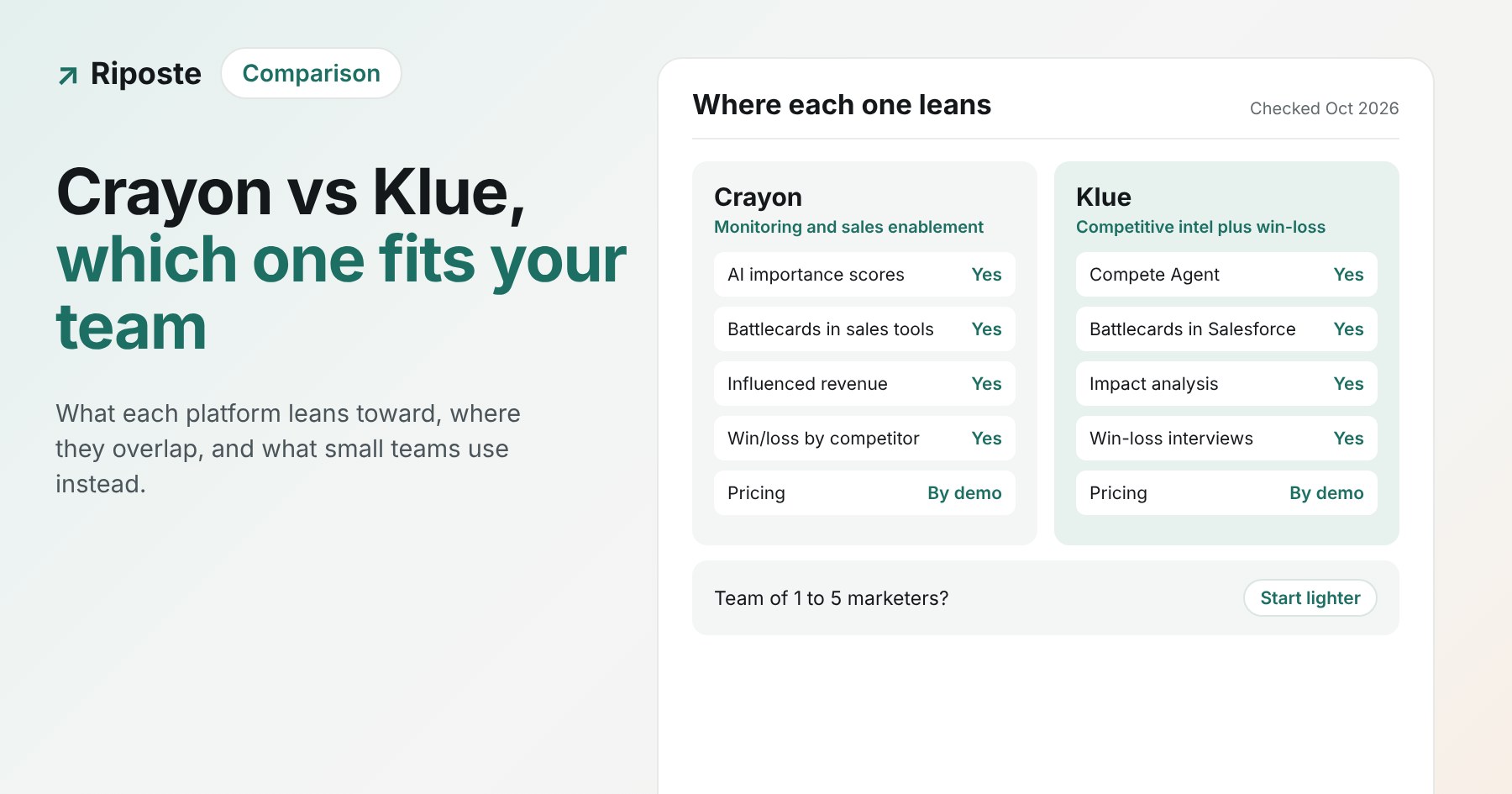
- Klue describes itself as a competitive enablement platform for B2B revenue teams. Its Compete Agent gathers insights from your CRM, sales calls, win-loss data and public sources, battlecards are created and refreshed with AI, and a win-loss program runs buyer interviews.
- Crayon describes itself as a competitive intelligence platform focused on helping sales win. Crayon AI summarizes competitor news and scores how important each change is, battlecards show up in tools like Salesforce, Slack and Highspot, and reports cover win/loss and influenced revenue.
Neither publishes prices, and both start with a demo. Much of the value sits in features a solo PMM at an early-stage company may not use yet: battlecards inside the CRM, deal support for a large sales team, win-loss interviews and revenue reporting. They also work best when someone owns the program and curates it every week.
If that's not your situation yet, you're likely to pay for more than you use. I've compared the two side by side in Crayon vs Klue, and kept separate pages on Klue alternatives and Crayon alternatives.
The question that decides it
Ask: "Do I need to run a competitive program for a sales team, or do I need to know what changed and respond fast?" The first points to an enterprise platform. The second points to something lighter.
What page monitors do, and what they leave to you
Page monitors like Visualping sit at the other end. You pick the pages, it checks them on a schedule and tells you when something changes. Visualping now writes an AI summary of each change, and you can set your own criteria so it only alerts you about changes that matter, like a pricing change or a new feature. It has a free plan for a few pages.
That makes it a cheap, good start for one or two pricing pages. What it leaves to you:
- Finding the pages. You add each URL yourself, for every competitor.
- Judging the change for your product. A price rise can be a threat for one company and an opening for another. The monitor doesn't know your positioning.
- The response. Updating the battlecard, briefing sales or changing your comparison page is still a blank page.
For a solo PMM, those three steps are where the week goes.
What to look for in a CI tool when you're a team of one
Use this as a checklist in any demo or free trial:
- It finds the right pages on its own. Pricing, release notes, blog, blog feed and sitemap, from just the competitor's website.
- It checks daily, without you. You shouldn't have to remember to run anything.
- It filters noise. Changed dates, cookie banners and rotating testimonials shouldn't reach you.
- It sorts changes by impact. High, medium and low, so you know what to read first.
- It explains changes for your product. Not "they changed pricing", but what that means for your deals.
- It drafts the response. A battlecard update, a talk track or a post you can edit, not just an alert.
- It reaches you where you work. Email or Slack for the important changes, and a weekly digest for the rest.
- Setup takes minutes, and you can try it first. No onboarding project and no sales call before you see it work.
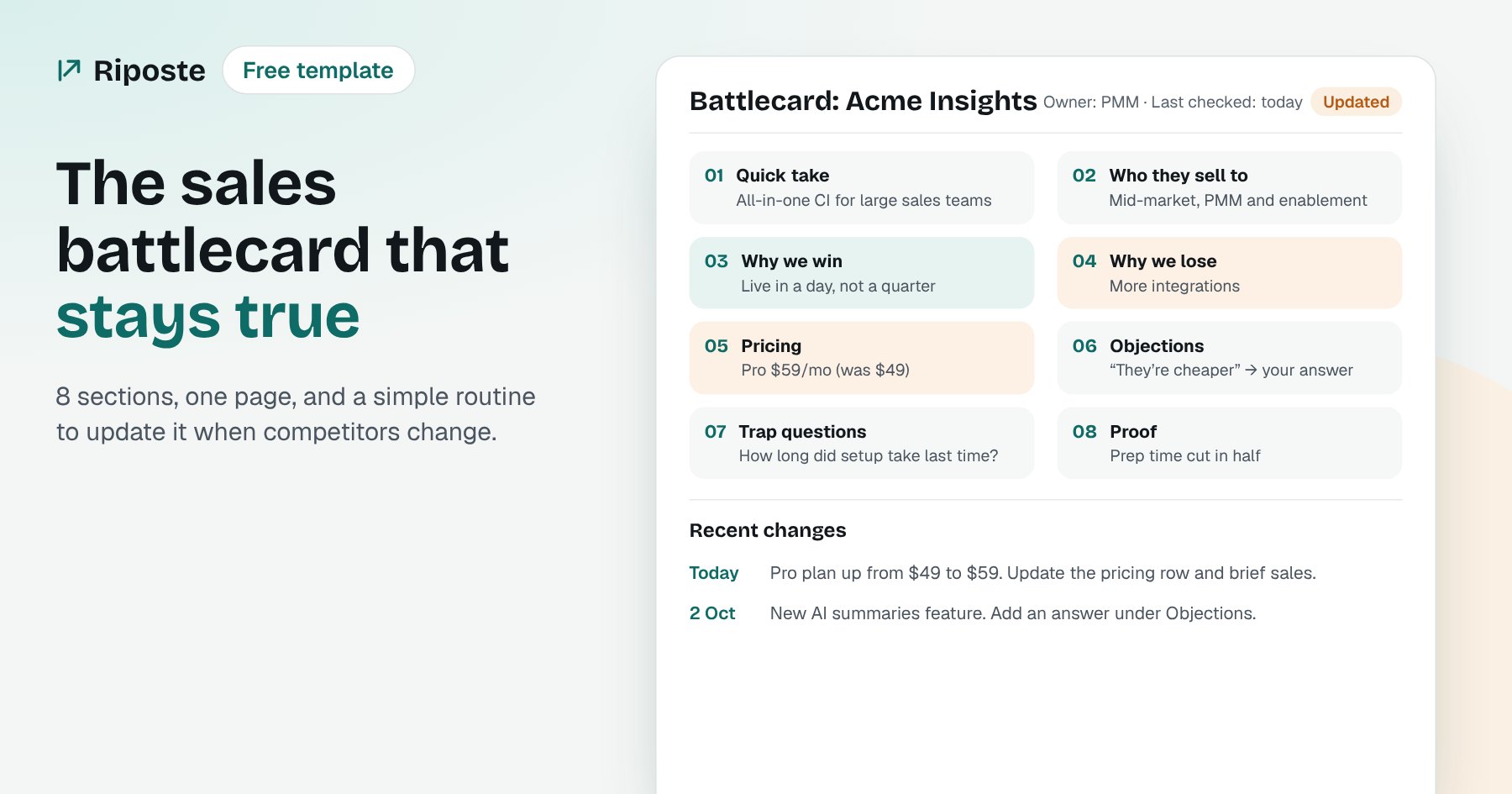
If you don't have a battlecard yet, start one now with the free battlecard generator. It drafts a one-page card from a competitor's website, and you'll know what good looks like before you judge any tool.
Klue vs Crayon vs Visualping vs Riposte for a solo PMM
| Tool | Built for | Drafts the response | Pricing |
|---|---|---|---|
| Klue | B2B revenue teams | AI battlecards for sellers | By demo |
| Crayon | CI, PMM and sales teams | Battlecards you build | By demo |
| Visualping | Watching pages you pick | No | Free plan, then paid |
| Riposte | Teams of 1 to 5 marketers | Tasks, owners and drafts | Free in the beta |
Klue, Crayon and Visualping details from their own websites, checked 23 and 26 October 2026.
Pick Klue if win-loss matters as much as tracking competitors and your sellers work in Salesforce. Pick Crayon if you need to get intel to a large sales team and show it helped. Pick Visualping if you only need to watch a few pages cheaply and are happy to judge each change yourself.
Riposte is the one I build, for the PMM I was, checking competitor pages by hand every Monday. It checks your competitors' pricing pages, release notes, blogs and sitemaps every morning, ignores noise, and turns each real change into a signal: what changed, why it matters for your product, and what to do. High-impact changes reach you by email or Slack, with who does what, and a digest arrives every Monday. One click turns a signal into an action kit with a first draft. During the beta you can track up to 5 competitors.
Track what AI assistants recommend, too
Buyers don't only search Google now. Some ask an AI assistant "what's the best tool for…" and get a short list of names. If your competitors are on that list and you aren't, you lose that buyer before they reach your site.
What to track:
- The buying questions your customers would ask, written without brand names.
- Which brands the answers name, and how often you show up next to competitors.
- Which sites the answers rely on, because those are the places worth getting listed or cited on.
Riposte asks your buyers' questions in Gemini with Google Search every week and records the brands named and the sites cited. Each gap can become a content brief. AI answers change from run to run, so treat this as a trend, not an exact score.
A lean weekly CI routine for a solo PMM
This is the routine I'd run as a team of one, with or without a tool. If you also send leadership a weekly update, I've written about what a good executive digest looks like.
- Pick 3 to 5 competitors. The ones you lose deals to, not everyone in your category.
- Watch the pages that change deals. Pricing, release notes or changelog, blog, and sitemap for new pages.
- Read high-impact changes the day they happen. Leave the rest for a weekly review.
- Ask one question per change: does this change what sales says on a call? If not, log it and move on.
- If yes, update the battlecard that week and post one line in the sales channel saying what changed.
- Once a month, check AI answers for your top buying questions, and note who gets named.
The log matters more than it looks. After a couple of months, you'll see patterns, like a competitor that changes pricing every quarter or always launches before a big event.
Where Riposte fits, and where it doesn't
Riposte is a good fit if you:
- Are a solo PMM, a small marketing team or a founder doing the marketing
- Track up to 5 competitors and want them checked every morning
- Want each change explained for your product, with the response drafted
- Want to see who AI assistants recommend for your buyers' questions
Choose something else if you:
- Need battlecards inside Salesforce or another CRM for a large sales team
- Run win-loss interviews
- Need to track more than 5 competitors today, or monitor X and LinkedIn
Wrapping up
For a solo product marketer, the best competitive intelligence tool is the one that gives you back the checking and the first draft, so your time goes into the judgment calls. Enterprise platforms like Klue and Crayon are worth it once you run a CI program for a large sales team. Until then, start light: a few competitors, the pages that change deals, and a weekly routine you can actually keep.
Sources
- Klue: official information page, checked 26 October 2026
- Klue homepage, checked 23 October 2026
- Crayon homepage, checked 23 October 2026
- How Visualping uses AI to monitor web changes, checked 26 October 2026
- Visualping pricing, checked 23 October 2026
The bottom line
If you are the only product marketer, choose the tool that does the checking and drafts the first response, not the one with the longest feature list. Enterprise platforms pay off once you have a CI program and a large sales team to run it for.
Frequently asked questions
What is the best competitive intelligence tool for a solo product marketer?
The best fit is a tool that checks competitors automatically and helps you respond, without setup or a program to run. Riposte is built for teams of 1 to 5 marketers and is free during its beta. If your company already runs a CI program for a large sales team, Klue or Crayon fit better.
Do early-stage B2B SaaS startups need enterprise platforms like Klue or Crayon?
Usually not yet. Klue and Crayon are built for revenue teams, with battlecards inside sales tools, CRM integrations and win-loss programs. An early-stage team with one marketer and a small sales team gets most of its value from daily monitoring and fast responses, which lighter tools cover.
How is a competitive intelligence tool different from a website monitor like Visualping?
A website monitor like Visualping watches any page you choose, summarizes each change and can alert you only on changes that match your criteria. A competitive intelligence tool finds the competitor pages worth watching for you, judges each change against your own product and helps you build the response, such as a battlecard update.
How much time does automated competitive intelligence save a solo PMM?
It depends on how many competitors you track and how often they change. The time you get back is mostly the checking and the first draft: you no longer open every pricing page by hand, and you start from a draft instead of a blank page.
Can competitive intelligence tools track what AI assistants like Google Gemini recommend to buyers?
Some can. Riposte asks your buyers' questions in Gemini with Google Search every week and records which brands the answers name and which sites they rely on. Treat the results as a trend, because AI answers change from run to run.
How much do Klue and Crayon cost?
Neither publishes prices. As of 23 October 2026, both websites ask you to book a demo, so you need a quote for your team.
What is a good Klue alternative for a startup?
For a startup with one or two marketers, a lighter tool like Riposte or a page monitor like Visualping is usually enough to start. Riposte suits you if you want each change explained for your product and the response drafted, and Visualping suits you if you want to watch a few specific pages cheaply.
What is a good Crayon alternative for a small team?
Small teams often choose a lighter tool that checks competitors daily without onboarding or an annual contract. Riposte is built for teams of 1 to 5 marketers and is free during its beta, while Kompyte and Visualping are other common options.
How many competitors should a solo product marketer track?
Start with 3 to 5: the competitors you lose deals to most often. Tracking more spreads one person too thin, and most of the value comes from responding well to a few competitors.
What should a solo PMM do when a competitor changes pricing?
Check the change on their pricing page, decide whether it changes what sales says on a call, and if it does, update the battlecard and post one line in the sales channel that week. Log the change either way, so you can see patterns over time.