Saniya Gazala
In short
If your product marketing team has to keep leadership up to date on competitors, judge CI software on the digest it sends, not the number of alerts. Crayon sends a daily morning email of the most important insights, Contify sends scheduled executive newsletters, RivalSense and Competely send weekly briefs, and Riposte sends a Monday digest by email and Slack with each change sorted by impact and what your team shipped. Klue's leadership reporting centers on win-loss. Checked on each vendor's own site on 26 and 27 October 2026.
On this page
- 01What makes a good executive digest
- 02The tools, by the digest they send
- 03Enterprise platforms: Crayon, Klue and Contify
- 04Lighter tools: RivalSense, Competely and Riposte
- 05From digest to action
- 06Report on AI visibility, too
- 07How to choose
- 08Wrapping up
- 09Sources
- ✓The bottom line
- ?Frequently asked questions
Every product marketing team gets the same question from leadership sooner or later: "What are our competitors up to?" Answering it once is easy. Answering it every week, in a form busy people will read, is the hard part.
Most CI software reviews compare how much data each tool collects. This guide compares something narrower: the digest each tool sends, and how much of the follow-up work it does. I checked every tool on its own website on 26 and 27 October 2026. I build one of them, Riposte, so I'll be clear about its limits too.
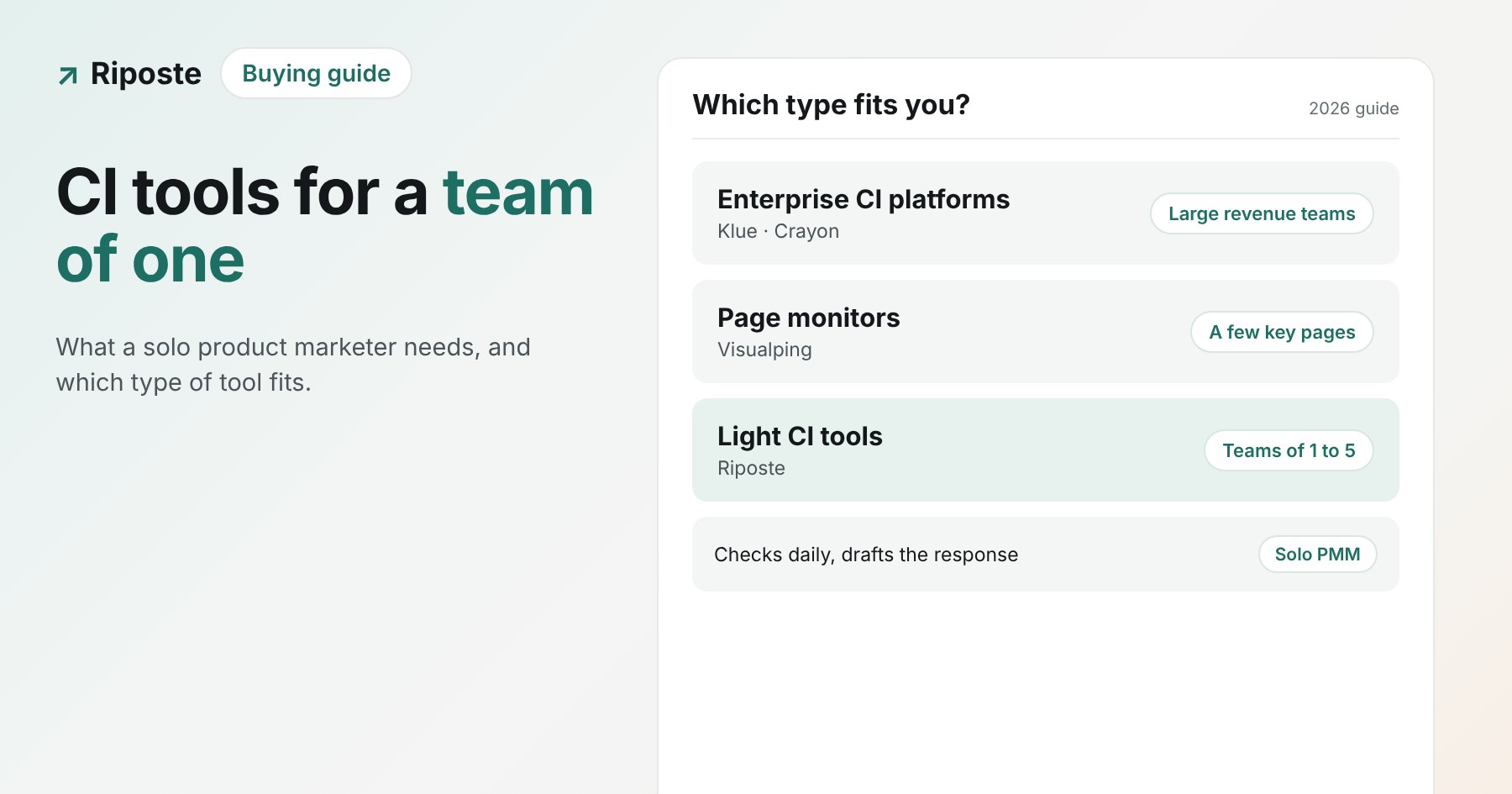
If you're the only marketer and nobody asks you for reports, my guide to CI tools for a solo product marketer fits you better.
What makes a good executive digest
Leadership doesn't want every change. They want to know what matters and whether someone is on it. A good digest:
- Leads with the few changes that matter most, sorted by impact, not by date.
- Says what each change means for the business, in one or two sentences.
- Ends with what the team is doing, so leadership doesn't have to ask.
- Fits on one screen, with a link to the full feed for anyone who wants more.
- Arrives on a steady schedule, usually weekly, with urgent changes flagged the same day.
The test is simple: could someone read it in two minutes between meetings and know what to say if a customer asks?
A one-page digest template
If you write the digest yourself, or want to judge a tool's output, use this:
Competitor digest, week of [date]

TOP CHANGES (most important first)
1. [Competitor]: [what changed, with the number or quote]
   Why it matters: [one sentence for our business]
   What we're doing: [action, owner, date]
2. ...

WORTH KNOWING
- [Competitor]: [smaller change, one line]

SHIPPED THIS WEEK
- [Battlecard update, talk track, page change]

COMING UP
- [Anything we expect next week]
The tools, by the digest they send
| Tool | What leadership gets | How often | Best for |
|---|---|---|---|
| Crayon | Email of the most important insights | Every morning | Large sales teams |
| Klue | Win-loss trends and leadership reporting | As deals close | Sales enablement and win-loss |
| Contify | Executive newsletters from templates | On a schedule you set | Company-wide market news |
| RivalSense | Briefings by email or Slack | Weekly | Small teams on a budget |
| Competely | Brief emails you can share with execs | Weekly to monthly, by plan | Self-serve analysis and briefs |
| Riposte | Monday digest by email and Slack | Weekly, plus high-impact alerts | Teams of 1 to 5 marketers |
Checked on each vendor's own site on 26 and 27 October 2026. Features change, so check before you buy.
Enterprise platforms: Crayon, Klue and Contify
Crayon
Crayon is built to get competitor intel to sales. Its aggregation page says it collects website changes, pricing updates, news, support documents and customer reviews, plus intel from call recordings in tools like Gong and Chorus.
For digests: Crayon sends an email every morning summarizing the previous day's most important insights. Important intel can also be pushed to chosen Slack channels in real time, and with Crayon Answers, reps can type /crayon and a question in Slack to get an answer.
Best for CI and product marketing teams supporting a large sales team. Pricing isn't published.
Klue
Klue describes itself as a competitive enablement platform for B2B revenue teams. Its Compete Agent gathers insights from your CRM, sales calls, win-loss data and public sources, and Deal Tips brief sellers when a competitor shows up in a deal.
For digests: Klue's leadership reporting centers on win-loss. Win & Loss Stories are generated from CRM data and Gong calls when a deal closes, alongside expert interviews and an AI interviewer, with trend analysis for leadership.
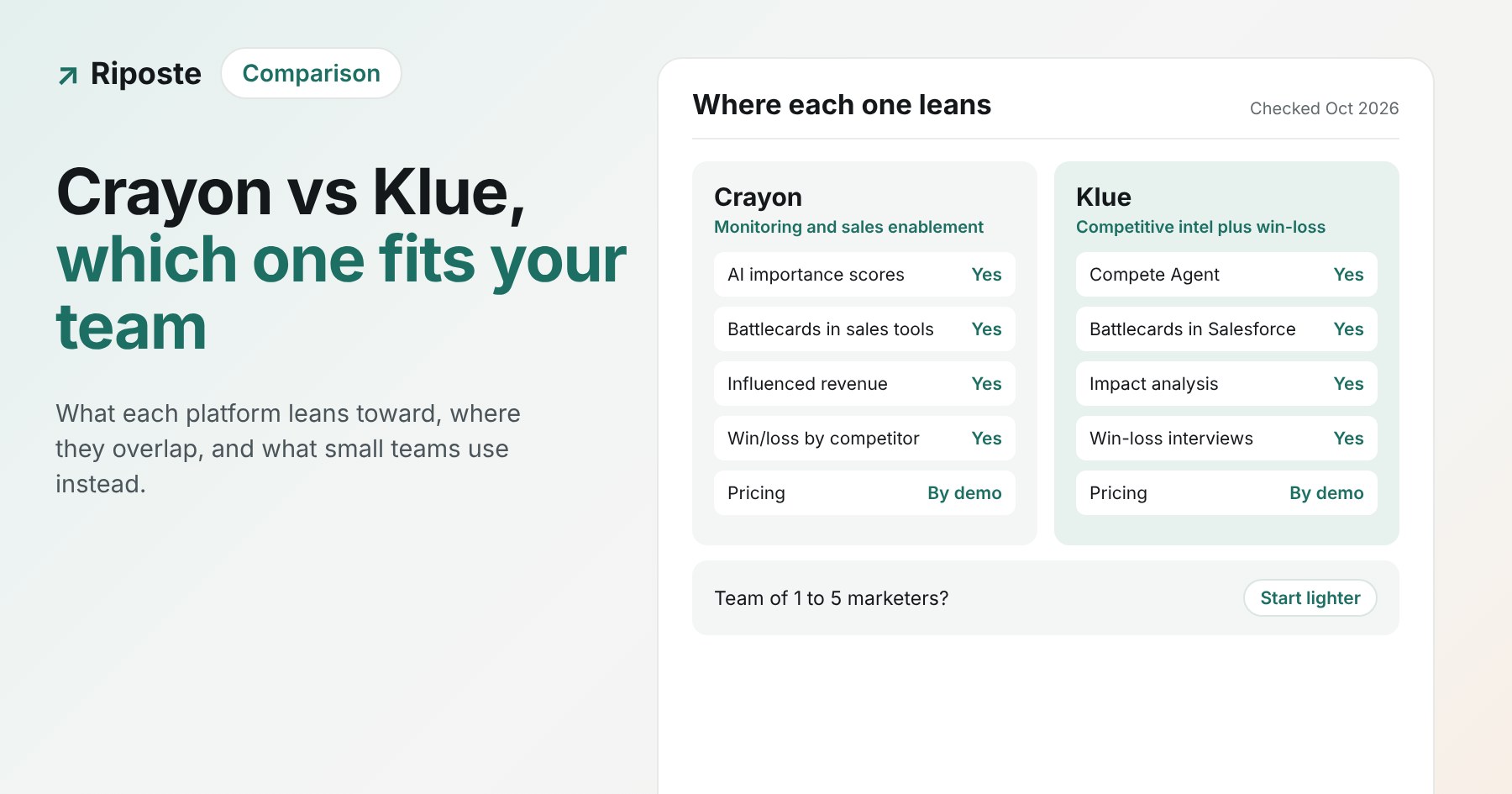
Best for teams where learning why you win and lose matters as much as tracking competitors. Pricing isn't published. I've compared the two in Crayon vs Klue.
Contify
Contify calls itself an AI-native market and competitive intelligence platform for organization-wide teams. It tracks leadership changes, SEC filings and regulatory portals, news, jobs, reviews and website changes.
For digests: this is where Contify stands out. It builds newsletters from templates for different functions, like strategy, sales and operations, and executives can get targeted alerts or full newsletters on a schedule. Intel also flows into Slack, Microsoft Teams and Salesforce.
Best for companies where several teams and leadership need market and competitor news. Pricing isn't published, and there's a 7-day free trial.
Lighter tools: RivalSense, Competely and Riposte
RivalSense
RivalSense says it monitors over 80 data sources, including websites, LinkedIn, job boards, registries and regulatory databases, with alerts on pricing changes and hiring.
For digests: weekly briefings by email or Slack, with a searchable archive.
Best for small teams that want a weekly competitor email at a lower cost. It offers a free trial.
Competely
Competely is a self-serve tool that builds a side-by-side analysis of your product against competitors, covering 100+ data points with sources for each, and monitors them for changes in pricing, features and messaging.
For digests: short brief emails when something meaningful changes, with what changed and why it matters. You can send them to teammates or execs, who don't need an account. Briefs are weekly on the Pro and Scale plans and every two weeks on Starter.
Best for quick competitor analyses and lightweight briefs. As of 27 October 2026, paid plans run from $39 to $99 a month, and you can start free with 2 competitors.
Riposte
Riposte is the tool I build, for teams of 1 to 5 marketers. Every morning it checks your competitors' pricing pages, release notes, blogs and sitemaps, ignores noise, and turns each real change into a signal: what changed, why it matters for your product, and what to do. Each signal is marked high, medium or low impact.
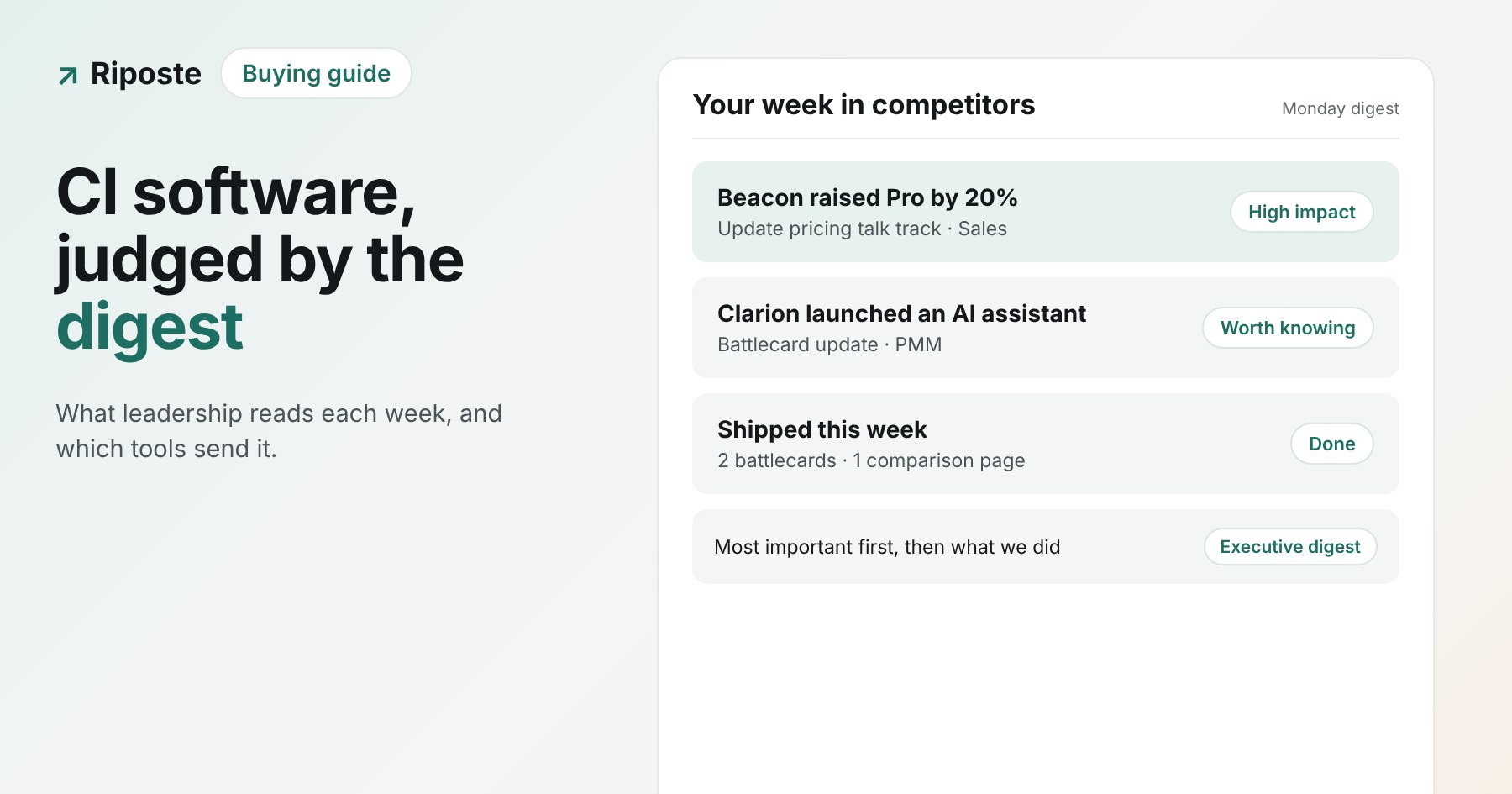
For digests: every Monday, Riposte sends a digest by email, and to a Slack channel if you connect one. Changes come most important first, each with what changed, why it matters and what to do. It also lists what your team shipped in response that week and what's still open, which is usually the first thing leadership asks. High-impact changes don't wait for Monday: they're sent the same day.
Limits: during the beta, Riposte tracks up to 5 competitors. It sends alerts and digests by email and Slack, and has no CRM integration.
Best for small marketing teams that report to leadership and want the response drafted, not just the alert. It's free during the beta. You can join the waitlist at useriposte.com.
From digest to action
A digest that only lists changes leaves leadership with the obvious next question: "So what are we doing about it?" The best answer is already in the digest.
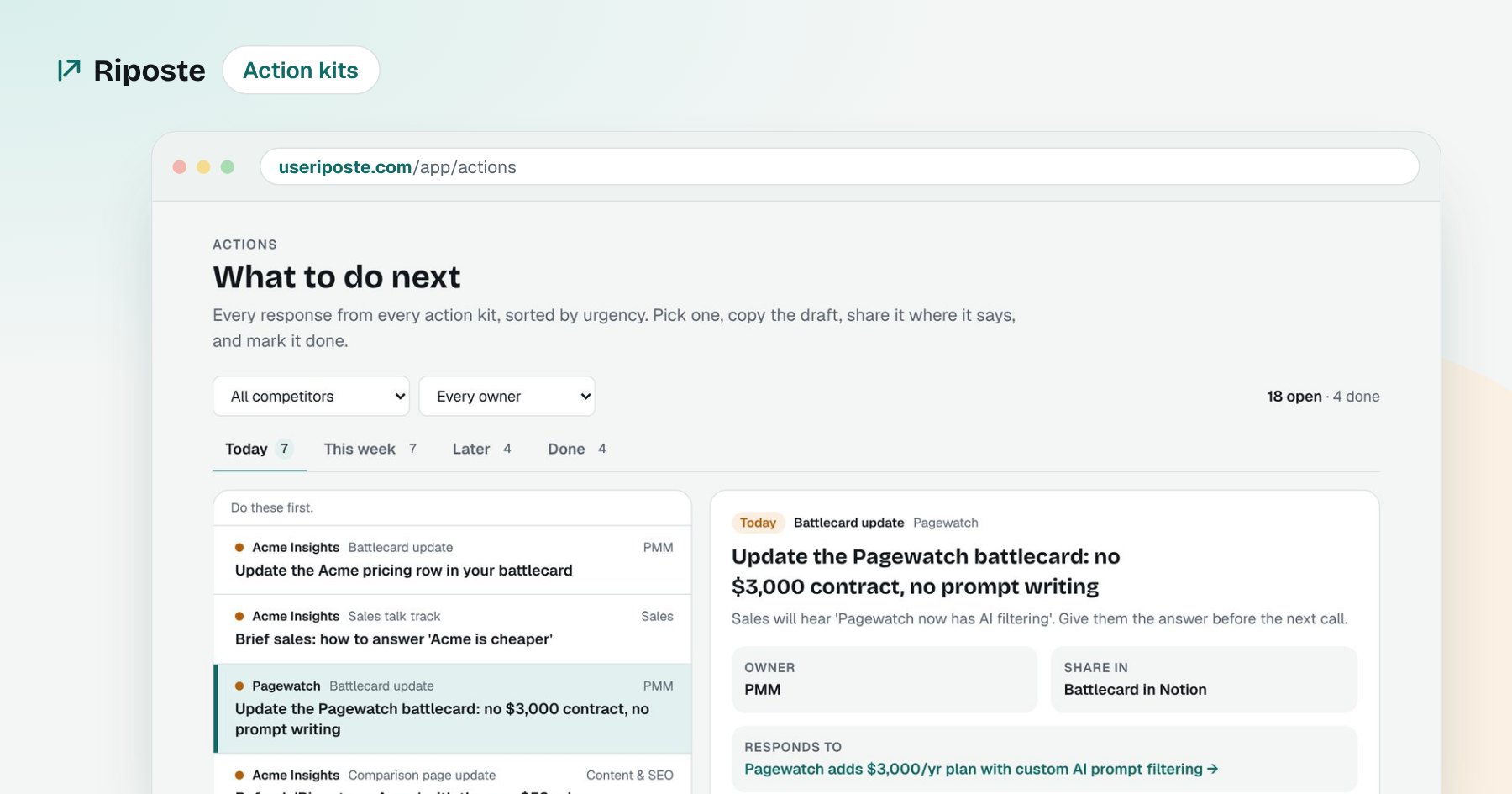
That's the difference between an alert and an action kit. An alert says a competitor changed its pricing page. An action kit says what to create in response, who owns it, where to share it and how urgent it is, with a first draft of the battlecard update, talk track or post. When those responses ship, they show up in the next Monday digest as "shipped this week".
Report on AI visibility, too
Some leadership teams now ask a newer question: "When buyers ask ChatGPT or Gemini, do we come up?" Tracking competitors' websites won't answer it.
To report on it, you need three things:
- The buying questions your customers would ask an AI assistant, written without brand names.
- Which brands the answers name, and your share compared with competitors.
- Which sites the answers rely on, because those are the places to get listed on.
Riposte asks your prompts in Gemini with Google Search every week and records the brands named and the sites cited. AI answers change from run to run, so report the trend over a few weeks, not one week's result.
How to choose
- Start with your reader. Sales reps need battlecards in their tools. Leadership needs a short weekly digest. Pick the tool built for the person who reads the output.
- Decide where the intel comes from. Internal sources like CRM data and call recordings point to Klue or Crayon. External competitor changes point to the lighter tools.
- Read a real digest before you buy. Ask for a sample from your own competitors, and check it against the template above.
- Check what it does after the alert. Does it say what to do, or draft it?
- Check the limits and the price. Competitors, recipients, seats, and whether the price is published at all.
- Test it on your own competitors. Use a free trial or beta for a couple of weeks, so you see at least two digests.
Wrapping up
For a product marketing team, competitive intelligence only counts when it reaches the people who make decisions. Judge the software by the digest it sends: short, sorted by impact, clear about what it means, and honest about what the team is doing. The rest of the feature list matters less than whether leadership reads it every week.
Sources
- Crayon: competitive intelligence aggregation, checked 27 October 2026
- Crayon + Slack, checked 27 October 2026
- Introducing Crayon Answers, checked 27 October 2026
- Klue: official information page, checked 26 October 2026
- Klue Win-Loss, checked 27 October 2026
- Contify: competitive intelligence, checked 27 October 2026
- Contify: executive-ready intelligence newsletters, checked 27 October 2026
- Contify platform, checked 27 October 2026
- RivalSense: Crayon vs RivalSense, checked 27 October 2026
- RivalSense: AI-powered competitor analysis, checked 27 October 2026
- Competely homepage, checked 27 October 2026
- Competely: competitor monitoring, checked 27 October 2026
The bottom line
Choose CI software by the digest your leadership will actually read: short, sorted by impact, and ending with what the team is doing. More alerts don't make a better update.
Frequently asked questions
What is the best competitive intelligence software for product marketing teams?
It depends on who reads the output. For a large sales team, Klue or Crayon fit best. For leadership updates across the company, Contify's executive newsletters fit. For small marketing teams that want short weekly briefs, look at RivalSense, Competely or Riposte.
What should a competitive intelligence executive digest include?
A good executive digest leads with the two or three changes that matter most, says what each means for the business, and ends with what the team is doing about it. Everything else goes below, or links to the full feed. It should fit on one screen.
Which competitive intelligence tools send an executive digest automatically?
Crayon sends a daily morning email of the previous day's most important insights. Contify sends executive newsletters on a schedule. RivalSense sends weekly briefings by email or Slack, Competely sends brief emails that you can share with execs, and Riposte sends a Monday digest by email and Slack.
What is the difference between a raw CI alert and an action kit?
A raw alert tells you a competitor page changed. An action kit says what to do about it: what to create, who owns it, where to share it, and a first draft to edit.
Can competitive intelligence software monitor pricing changes and release notes automatically?
Yes. Most tools in this guide watch competitors' websites, including pricing pages. Riposte finds each competitor's pricing page, release notes, blog and sitemap from the website and checks them every morning.
How does competitive intelligence software track buyer visibility in AI search?
It asks the questions your buyers would ask an AI assistant and records which brands the answers name. Riposte asks your prompts in Gemini with Google Search every week and records the brands named and the sites cited, so you can report the trend to leadership.
How often should product marketing send a competitive digest to leadership?
Weekly works for most teams, with high-impact changes flagged the same day. A daily email suits teams in fast-moving markets, but leadership often stops reading anything more frequent than weekly.
Do I need Klue or Crayon to report competitive intelligence to executives?
No. Klue and Crayon are strong for sales enablement and win-loss, and both report on it. If your main job is a short weekly update for leadership, Contify, RivalSense, Competely and Riposte all send briefs or digests.
How much does Competely cost?
As of 27 October 2026, Competely's site lists paid plans from $39 to $99 a month, and you can start free with an analysis of 2 competitors. Weekly briefs come with the Pro and Scale plans.
Does Riposte send digests to Slack?
Yes. Riposte sends a Monday digest by email, and to a Slack channel if you connect one, plus same-day alerts for high-impact changes. It has no CRM integration, and during the beta it tracks up to 5 competitors for teams of 1 to 5 marketers.