Saniya Gazala
In short
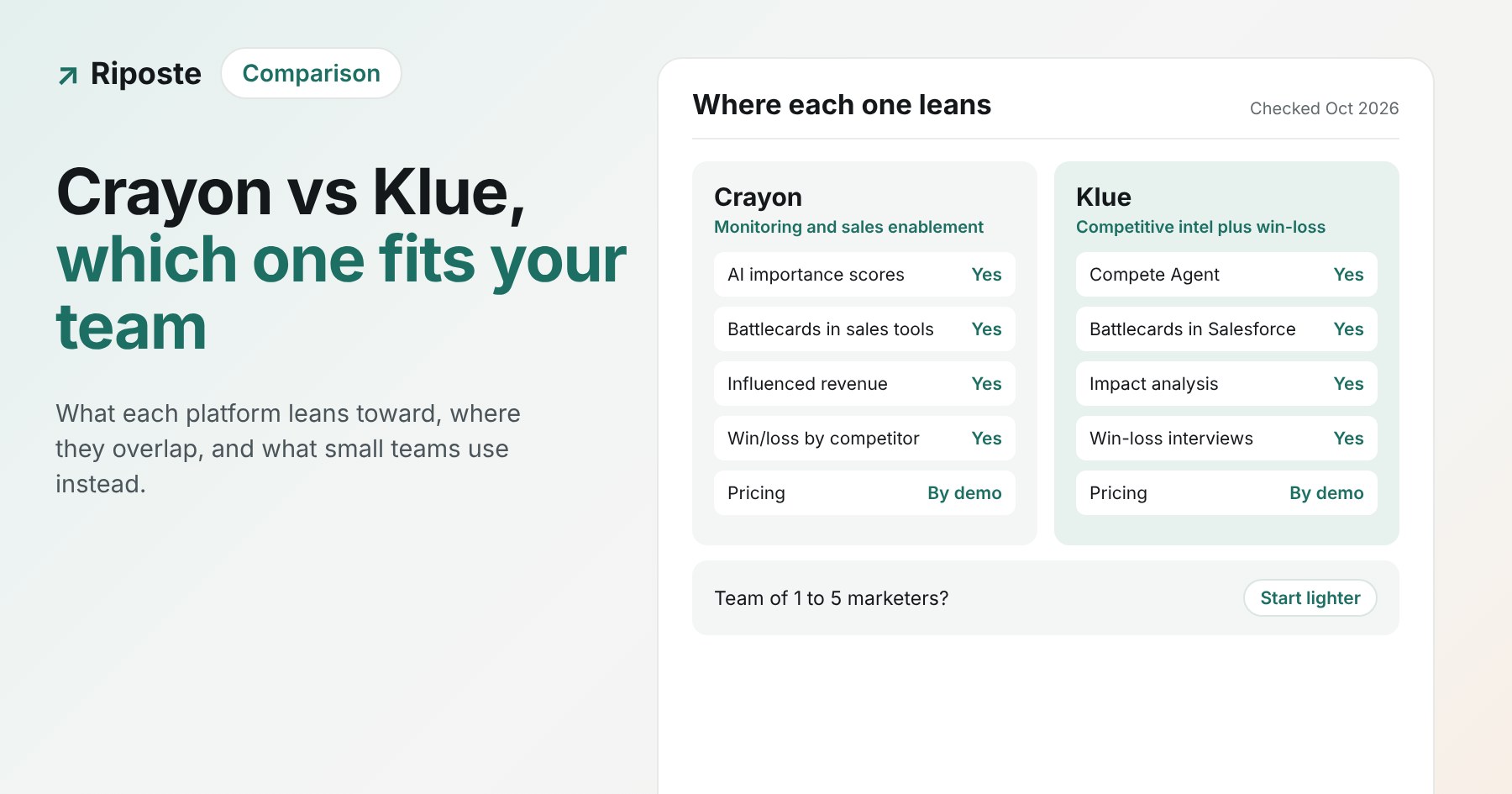
Crayon and Klue are both enterprise competitive intelligence platforms that sell by demo, with no public pricing. Crayon leans toward competitor monitoring and sales enablement, with AI importance scoring, battlecards and reports on influenced revenue. Klue leans toward win-loss, pairing its Compete Agent with buyer interviews run by people or an AI interviewer. Small teams of 1 to 5 marketers often need neither, and do better with a lighter tool.
Crayon and Klue come up in almost every competitive intelligence buying conversation. They are the two best known platforms in the category, and from the outside they look alike: both track competitors, both make battlecards, both sell by demo.
They are built around different jobs, though. I spent time on both websites this week to pin down where each one leans. Here's what I found, where each is the better pick, and what a small team should look at instead.
How I checked
Everything about Crayon and Klue below comes from their own websites, checked on 23 October 2026. No logos, no screenshots, no prices, because neither publishes them. If something changes, I'll update this post.
Crayon vs Klue at a glance
| Crayon | Klue | |
|---|---|---|
| Leans toward | Getting intel to sales | Intel plus win-loss |
| AI | Scores each change by importance | Compete Agent gathers intel |
| Battlecards | In Salesforce, Slack, Highspot | In Salesforce deals |
| Win-loss | Reports by competitor | Interviews, by people or AI |
| Impact | Influenced revenue | Win rate, deal size |
| Connects to | CRM, Slack, Teams, Gong | Salesforce, Glean |
| Pricing | By demo | By demo |
| Free plan | No | No |
Checked on crayon.co and klue.com on 23 October 2026.
What Crayon is best at
Crayon is built to get competitor intel to sales and prove it helped. Its homepage groups the product into four parts:
- Analyze: competitor monitoring, intel in your inbox, and Crayon AI, which summarizes news and ranks each change by importance.
- Enable: battlecards, announcements and newsletters, so the whole company hears about a competitor move.
- Compete: intel inside the sales tools reps already use, a leaderboard of top competitive winners, and manager coaching.
- Measure: win/loss by competitor, how reps use battlecards, and influenced revenue.
Its integrations page is long. It covers CRMs like Salesforce and HubSpot, chat tools like Slack and Microsoft Teams, enablement tools like Highspot, Seismic and Guru, and call recording tools like Gong and Chorus.
Crayon is the better pick if you have a CI or product marketing team supporting a large sales team, you want battlecards wherever reps work, and leadership wants to see revenue tied to competitive work.
What Klue is best at
Klue puts win-loss on the same level as competitive intel. Its homepage splits the product into two halves:
- Compete Agent: an AI research analyst and deal assistant that collects intel and brings it to sellers, through Auto Insights and Deal Support.
- Win-Loss Suite: Win-Loss Capture, human expert interviews, an AI Interviewer that holds short voice conversations with buyers and sellers, Blindspot Interviews with buyers from deals you weren't part of, and a Win & Loss Story Agent.
Inside Salesforce, Klue adds a Battlecard Button on opportunities, pushes deal notes back into Klue through Win-Loss Cards, and measures how Klue use lines up with win rate, sales cycle length and deal size. It also connects to Glean.
Klue is the better pick if you want to know why you win and lose deals, not only what competitors are doing, and your sellers live in Salesforce.
The one question that decides it
Ask yourself: "Is my biggest gap knowing what competitors changed, or knowing why we lose to them?" The first points to Crayon. The second points to Klue.
Where they are the same
For most teams, the overlap matters more than the differences:
- Both sell by demo. No public pricing, no free plan and no self-serve trial on either website as of 23 October 2026. Only a quote tells you your number, and it depends on team size and add-ons.
- Both are built for sellers. A lot of the value sits in battlecards inside the CRM, deal support and revenue reporting.
- Both expect someone to run them. You get the most out of either with a CI owner or a product marketer who curates the intel every week.
When neither is the right fit
I was a PMM tracking competitors by hand every Monday, and I can tell you the honest answer for a lot of teams: you don't need an enterprise platform yet.
Crayon and Klue are probably more than you need if:
- You are one to five marketers, or a founder doing the marketing.
- You track a handful of competitors, not twenty.
- Your sales team is small, or there isn't one yet, so CRM battlecards and rep leaderboards won't get used.
- You want to try a tool on your real competitors today, without a sales call.
In that case, look at the lighter tools in our guide to competitive intelligence tools. Kompyte, offered alongside Semrush, sits in the middle, with battlecards and automated workflows. Visualping has a free plan for up to 5 pages, though it only tells you that something changed.
And this is where Riposte, the tool I build, fits. It checks competitors' pricing pages, release notes, blogs and sitemaps every morning, explains each real change for your product, and drafts the response: what to create, who owns it and where to share it. It's free during the beta. It doesn't do CRM integrations or win-loss interviews, so if you need those, Crayon or Klue is the better choice.
If you're comparing one of them in depth, I keep a page on Crayon alternatives and one on Klue alternatives.
Start with a battlecard, whichever tool you pick
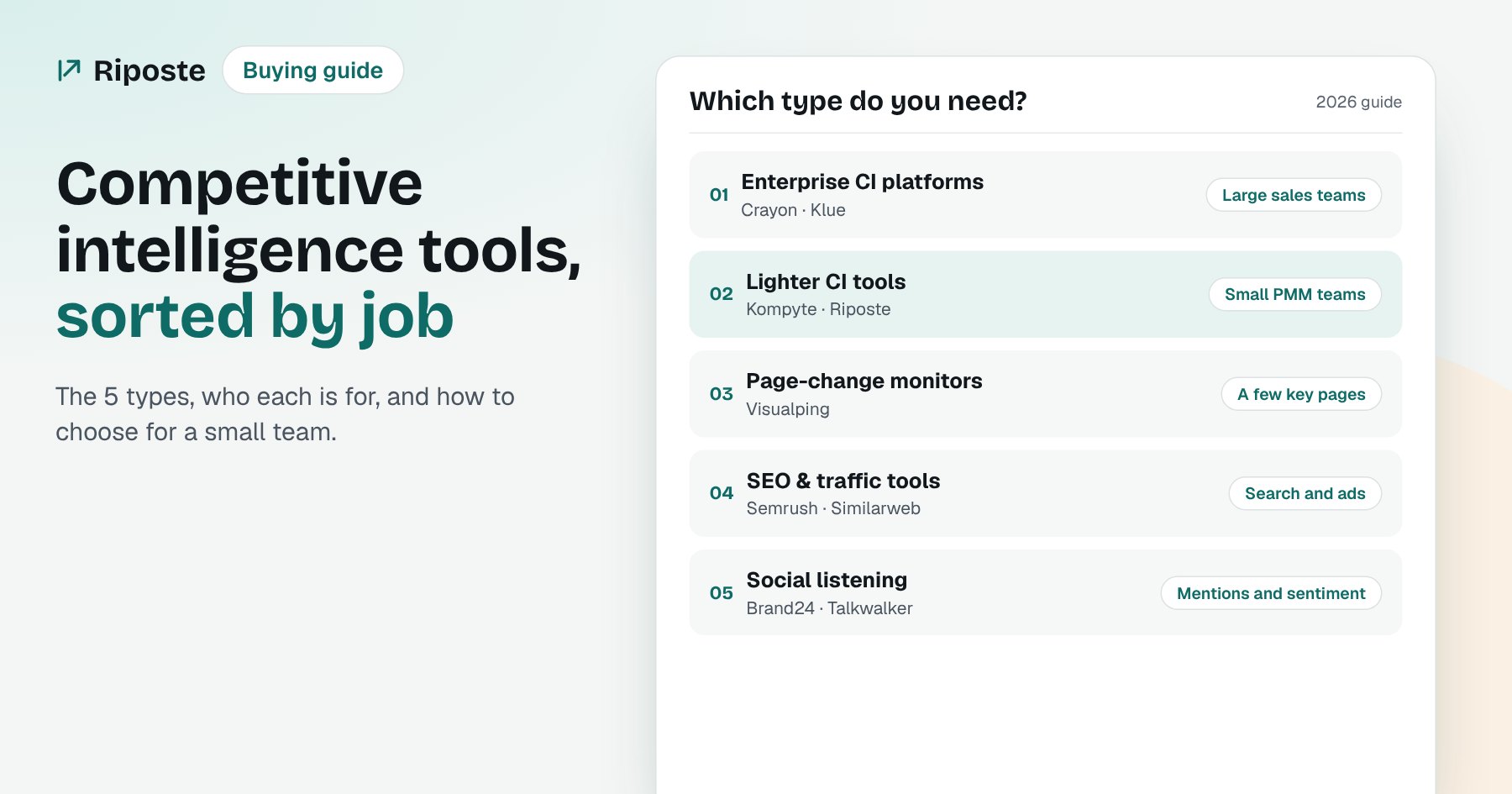
Whatever you choose, the output sales actually uses is the battlecard. If you don't have one yet, you can draft one in a couple of minutes with the free battlecard generator. Enter your product and a competitor's website, and it drafts a one-page card you can then edit.
Then, when you buy a platform, you already know what a good card looks like for your deals, which makes any demo easier to judge.
Wrapping up
Crayon and Klue are both serious platforms, and the choice between them comes down to one thing: Crayon is stronger on getting intel to sales and measuring it, and Klue is stronger on win-loss. If you're a large sales organization, book demos with both and test them on your own top three competitors.
If you're a small team, start lighter. The goal is the same either way: know what changed, decide what it means, and respond before your next deal does.
Sources
- Crayon homepage, checked 23 October 2026
- Crayon integrations, checked 23 October 2026
- Klue homepage, checked 23 October 2026
- Klue for Salesforce, checked 23 October 2026
- Kompyte on the Semrush knowledge base, checked 23 October 2026
- Visualping pricing, checked 23 October 2026
The bottom line
Pick Crayon if your priority is getting competitor intel into the hands of a large sales team. Pick Klue if learning why you win and lose deals matters as much. If you are a small marketing team, you probably need neither yet.
Frequently asked questions
What is the difference between Crayon and Klue?
Crayon is built around competitor monitoring and sales enablement, with AI that scores how important each change is. Klue pairs competitive intelligence with a win-loss suite, including interviews with buyers run by people or an AI interviewer.
Is Crayon or Klue better for win-loss analysis?
Klue, if win-loss is your main goal. Its Win-Loss Suite runs buyer and seller interviews, while Crayon's website describes win/loss analysis by competitor rather than an interview program.
Is Crayon or Klue better for battlecards?
Both are strong. Crayon puts battlecards in tools like Salesforce, Slack and Highspot and reports how reps use them. Klue adds a Battlecard Button inside Salesforce opportunities and feeds win-loss notes back into the cards.
How much do Crayon and Klue cost?
Neither publishes prices. As of 23 October 2026, both websites ask you to book a demo, and neither lists a free plan, so you need a quote for your team size.
Do Crayon and Klue have free plans?
No. As of 23 October 2026, neither website shows a free plan or a self-serve trial. Free options for small teams include Riposte during its beta, Google Alerts for news and Visualping's free plan for up to 5 pages.
Which integrates better with Salesforce, Crayon or Klue?
Both integrate with Salesforce. Klue's Salesforce page is more detailed, with a battlecard button on opportunities, win-loss notes synced into Klue and reports that compare Klue use with win rates.
Is Crayon or Klue better for a small marketing team?
Usually neither. Both are built for larger companies with a CI or enablement program and a big sales team. A team of 1 to 5 marketers often gets more from a lighter tool that checks competitors daily and drafts the response.
What is a good alternative to Crayon and Klue?
Kompyte, offered alongside Semrush, is a mid-weight option with battlecards and automated workflows. Riposte is a lighter option for small teams, free during its beta, that explains each competitor change for your product and drafts what to do next.
Can I use Crayon or Klue without a sales team?
You can, but you will pay for features built for sellers, like CRM battlecards, rep leaderboards and deal support. Without a sales team, most of the value is in the monitoring, which lighter tools also cover.
How long does it take to set up Crayon or Klue?
Both start with a demo and onboarding, and the full value comes after you connect your CRM and sales tools. Lighter tools can be set up in minutes by adding competitor websites.