Saniya Gazala
In short
Competitive intelligence software for sales playbooks should do more than alert you: it should help you update the battlecard, talk track and objection reply when a competitor changes. Klue, Crayon and Kompyte are built for sales teams, with battlecards inside tools like Salesforce and, for Klue, insights from Gong calls. Riposte is lighter: it checks competitors' websites every morning and drafts the battlecard update and talk track for you to review, with Slack and email alerts but no CRM or Gong integration.
On this page
- 01What a sales playbook needs to stay current
- 02Alerts vs action: the battlecard maintenance problem
- 03Competitive intelligence software for sales playbooks, compared
- 04Example: from a price change to an updated playbook
- 05AI search and sales playbooks
- 06Choosing by team size
- 07How to run it with your sales team
- 08Wrapping up
- 09Sources
- ✓The bottom line
- ?Frequently asked questions
Sales reps stop trusting a battlecard the first time it's wrong on a call. A competitor changed its pricing last month, the card still shows the old number, and the buyer knows it. After that, reps go back to asking in Slack, or guessing.
So for sales, the hard part of competitive intelligence isn't finding out what changed. It's turning each change into an updated sales playbook: the battlecard row, the talk track, the objection reply. This guide compares competitive intelligence software on that job. I checked every tool on its own website on 26 and 27 October 2026, and I build one of them, Riposte, so I'll be clear about its limits.
What a sales playbook needs to stay current
For this guide, a sales playbook is what reps use when a competitor comes up in a deal:
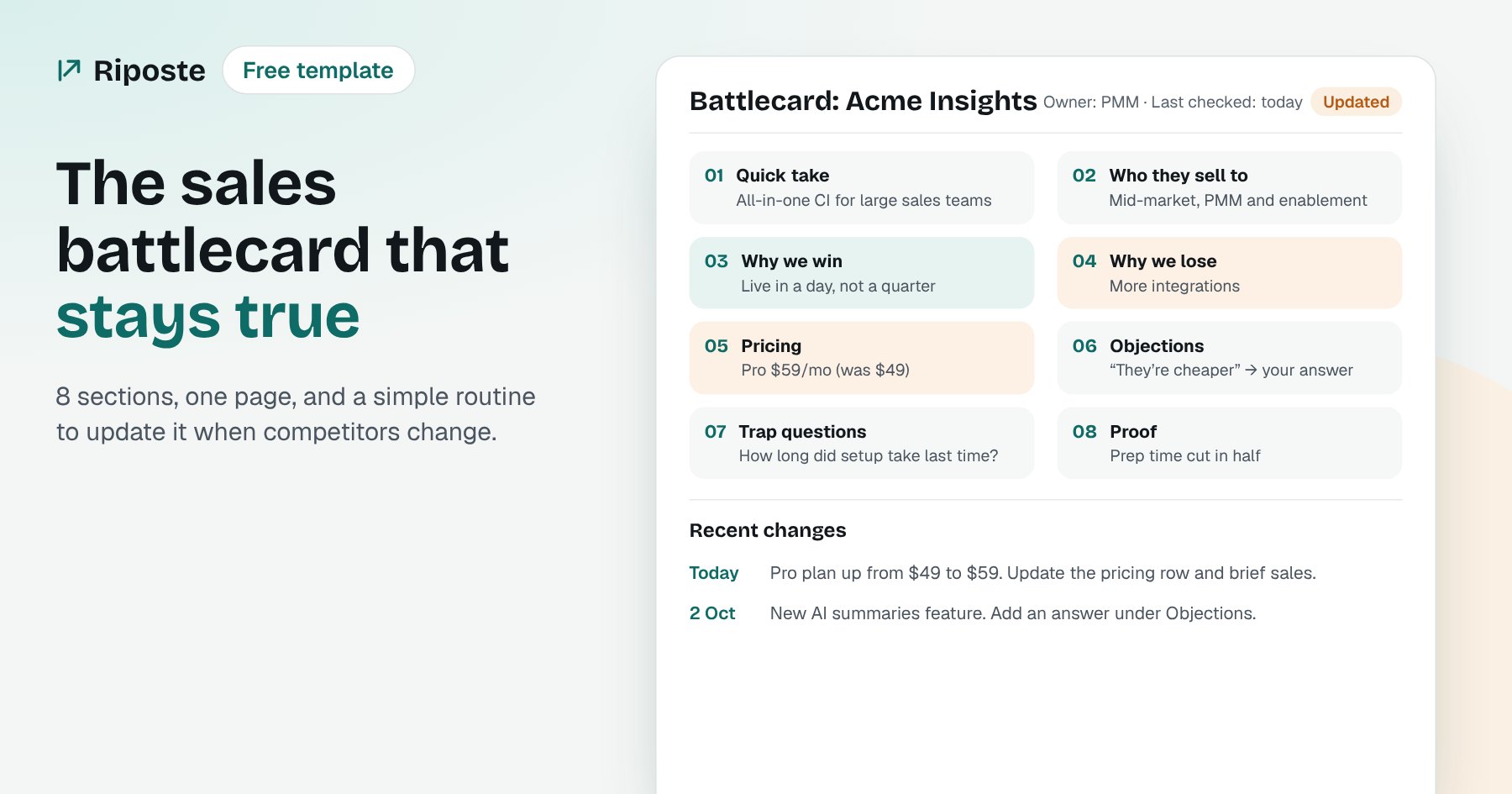
- The battlecard: one page per competitor, with why you win, why you lose, pricing, objections and questions to ask. My sales battlecard template covers the 8 parts.
- Talk tracks: short, sayable lines for common moments, like "they just launched X".
- Objection replies: the buyer's words, and an honest answer a rep can say in one or two sentences.
Each of these goes out of date when a competitor changes something. The most common triggers are a pricing change, a new feature in the release notes, a rewritten homepage, or a new comparison page.
Alerts vs action: the battlecard maintenance problem
Most competitive intelligence tools are good at the first step: noticing a change. The work that keeps sales playbooks current comes after:
- Decide if it matters. A new pricing tier changes deals. A changed footer doesn't.
- Decide what to change. Which battlecard line, which talk track, which objection?
- Write it. Draft the new line, check it, and tell sales.
An alert only covers step one. That's why battlecards drift: the alert arrives, but the rewrite waits for a quiet afternoon that never comes.
When you compare tools, check two things. Does it sort changes by impact (high, medium, low), so you know what to handle today? And does it help with step three, either by refreshing the card or by drafting the update for you?
Competitive intelligence software for sales playbooks, compared
| Tool | Battlecards | Where reps see them | Talk tracks and objections |
|---|---|---|---|
| Klue | Created and refreshed with AI | Salesforce, plus Deal Tips | From Gong calls, validated by PMMs |
| Crayon | Built in Crayon | Salesforce, Slack, Teams, Highspot and more | Answers in Slack via /crayon |
| Kompyte | Update once, updated everywhere | Salesforce, HubSpot, Slack, Teams, Highspot | Not stated on its page |
| Riposte | Drafted updates to review | Your own battlecards (copy from the app) | Drafted with one objection and answer |
Checked on each vendor's own site on 26 and 27 October 2026. Klue, Crayon and Kompyte don't publish prices.
Klue
Klue describes itself as a competitive enablement platform for B2B revenue teams. Its battlecards are created and refreshed with AI, and a Battlecard Button opens them from a Salesforce opportunity.
What stands out for sales playbooks is call data. Klue's Compete Agent connects to Gong, analyzes calls where a competitor comes up, and produces Auto Insights for PMMs, including talk tracks and objection handling, plus Deal Tips for sellers in live deals. Klue's own article on AI talk tracks says the PMM still validates them. It also runs win-loss programs.
Best for sales teams with Gong and Salesforce, where the best objection replies come from your own calls.
Crayon
Crayon is built to get competitor intel to sales. Its battlecards can be embedded in each Salesforce opportunity record, and Crayon says they can live in tools like Slack, Microsoft Teams, Highspot, Seismic and Guru. With Crayon Answers, reps type /crayon and a question in Slack and get an answer from your competitive content.
Crayon also shows which competitors come up in your deals and how often you win against them, and a leaderboard tracks reps in competitive deals.
Best for CI and product marketing teams supporting a large sales team that needs answers inside the tools it already uses.
Kompyte
Kompyte is competitive intelligence software offered with Semrush. Its page says it tracks competitors' pricing, product, hiring, messaging, reviews and advertising, and uses AI (KompyteGPT) to filter noise and summarize changes.
For sales playbooks, its battlecards are edited in one place and updated everywhere they're shared. It lists two-way integrations with Salesforce and HubSpot, plus Slack, Teams, Highspot and Showpad, and sends newsletters and email digests. Its page doesn't say how battlecards appear inside the CRM, so ask in a demo if that matters to you.
Best for go-to-market teams that want battlecards shared across many tools. I keep a page on Kompyte alternatives if you're comparing lighter options.
Riposte
Riposte is the tool I build, for B2B SaaS marketing teams of 1 to 5 people. Every morning it checks your competitors' pricing pages, release notes, blogs and sitemaps, plus news and YouTube, ignores noise, and marks each real change high, medium or low impact.
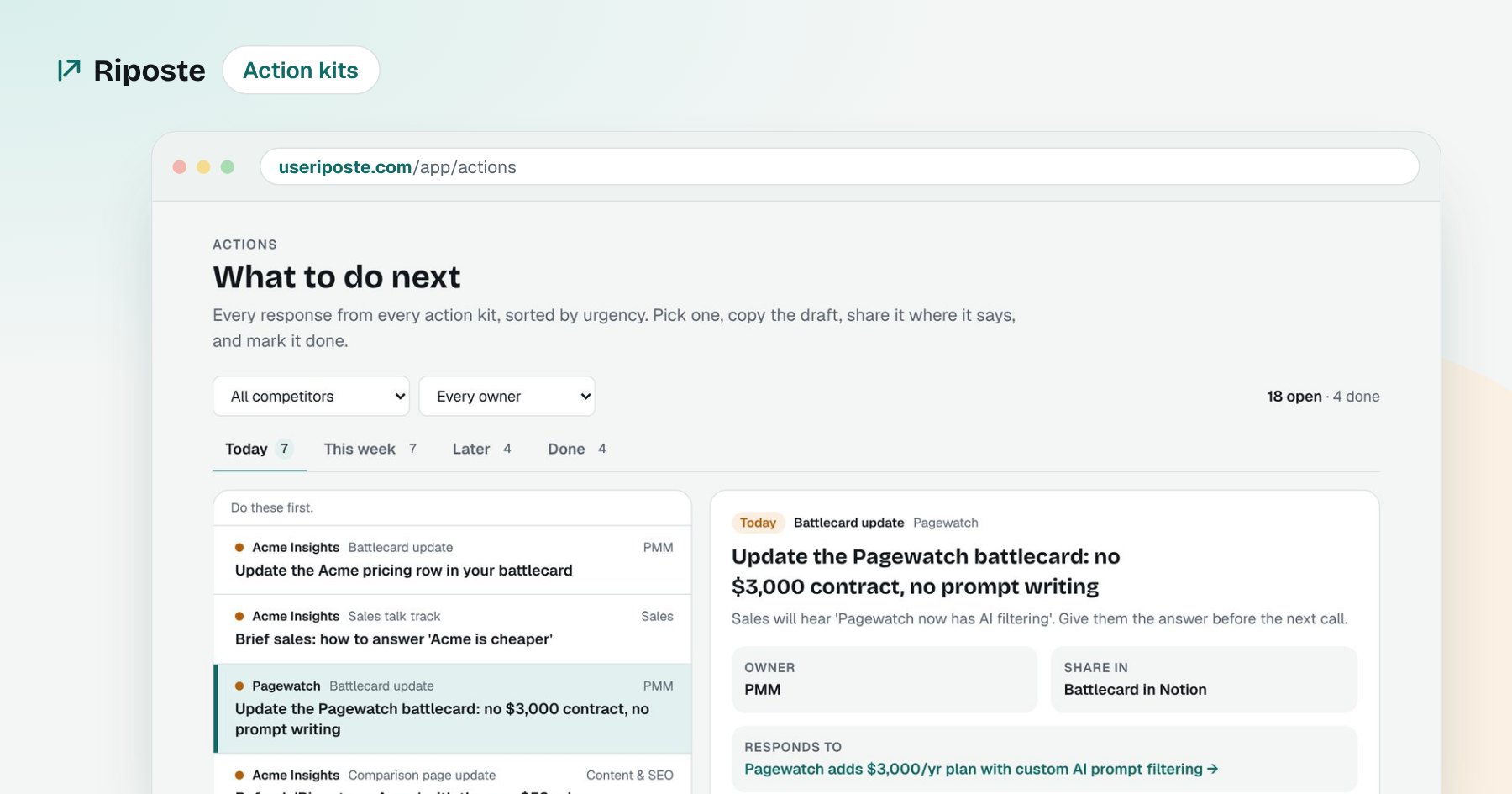
For sales playbooks, one click turns a change into an action kit: what to update, who owns it, where to share it, and a first draft. Drafts include a battlecard update, a talk track with one objection and its answer, and changes to your comparison page. You review the draft, then copy it into wherever your battlecards live.
Limits, plainly:
- Riposte sends alerts by email and Slack. It has no CRM or Gong integration, so it doesn't put cards inside Salesforce or learn from your calls.
- It watches websites, feeds, sitemaps, news and YouTube, not competitors' social media posts or ads.
- During the beta it tracks up to 5 competitors. It's free during the beta.
Best for small marketing teams without dedicated CI staff, who want the first draft of every battlecard update written for them.
Example: from a price change to an updated playbook
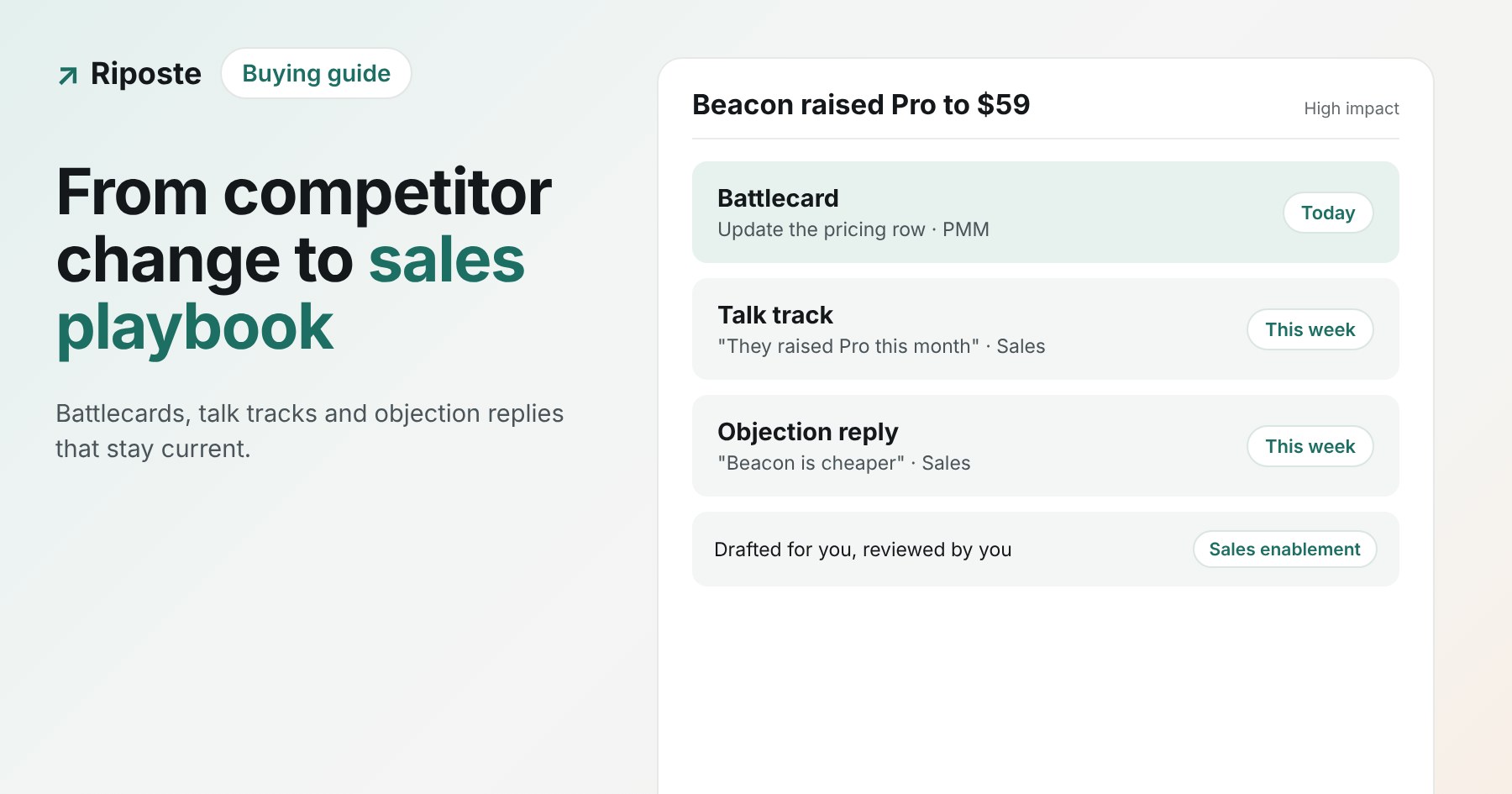
Here's how a change should flow, using made-up companies. Beacon raises its Pro plan from $49 to $59 a month.
- Battlecard: the pricing row changes to $59, dated, with one line on how Pro now compares with your plan.
- Talk track: "If Beacon came up on price, it's worth knowing they raised Pro to $59 this month. Let's compare what you'd pay for the features you need."
- Objection reply:
Buyer: "Beacon is cheaper."
Rep: "It was. Beacon raised Pro to $59 this month, so for
the plan you'd need, the gap is now [difference], and
you get [your strength] included."
The same change, handled the same week, keeps three pieces of the playbook true. If you don't have a battlecard to start from, the free battlecard generator drafts one from a competitor's website.
AI search and sales playbooks
Some buyers now ask an AI assistant "what's the best tool for…" before they talk to sales. If the answer names a competitor, reps may hear "ChatGPT recommended Beacon" on the first call.
For sales enablement, that means two things:
- Know which competitors AI assistants name for your buyers' questions, so reps aren't surprised.
- Prepare a reply for "I saw X recommended", using the same honest style as your other objection replies.
Riposte asks your buyers' questions in Gemini with Google Search every week and records which brands are named and which sites the answers rely on. It doesn't write the objection reply from that data; that's still a product marketer's judgment call.
Choosing by team size
Enterprise sales teams usually need:
- Battlecards inside the CRM, opened from the deal
- Insights from call recordings, like Gong
- Win-loss data and reporting on competitive deals
That points to Klue, Crayon or Kompyte. Riposte doesn't offer these.
Small marketing teams without CI headcount usually need:
- Daily checks of competitors' websites without anyone doing it by hand
- Changes sorted by impact
- A first draft of the battlecard update and talk track
That's where a lighter tool like Riposte fits.
Check the sources, too. If competitors' ads or social posts drive your deals, pick a tool that lists them; Kompyte's page names advertising. If pricing pages, release notes and blogs matter most, as they do for most B2B SaaS teams, a website-focused tool covers it.
How to run it with your sales team
- Route high-impact alerts to the product marketer, by Slack or email, the same day.
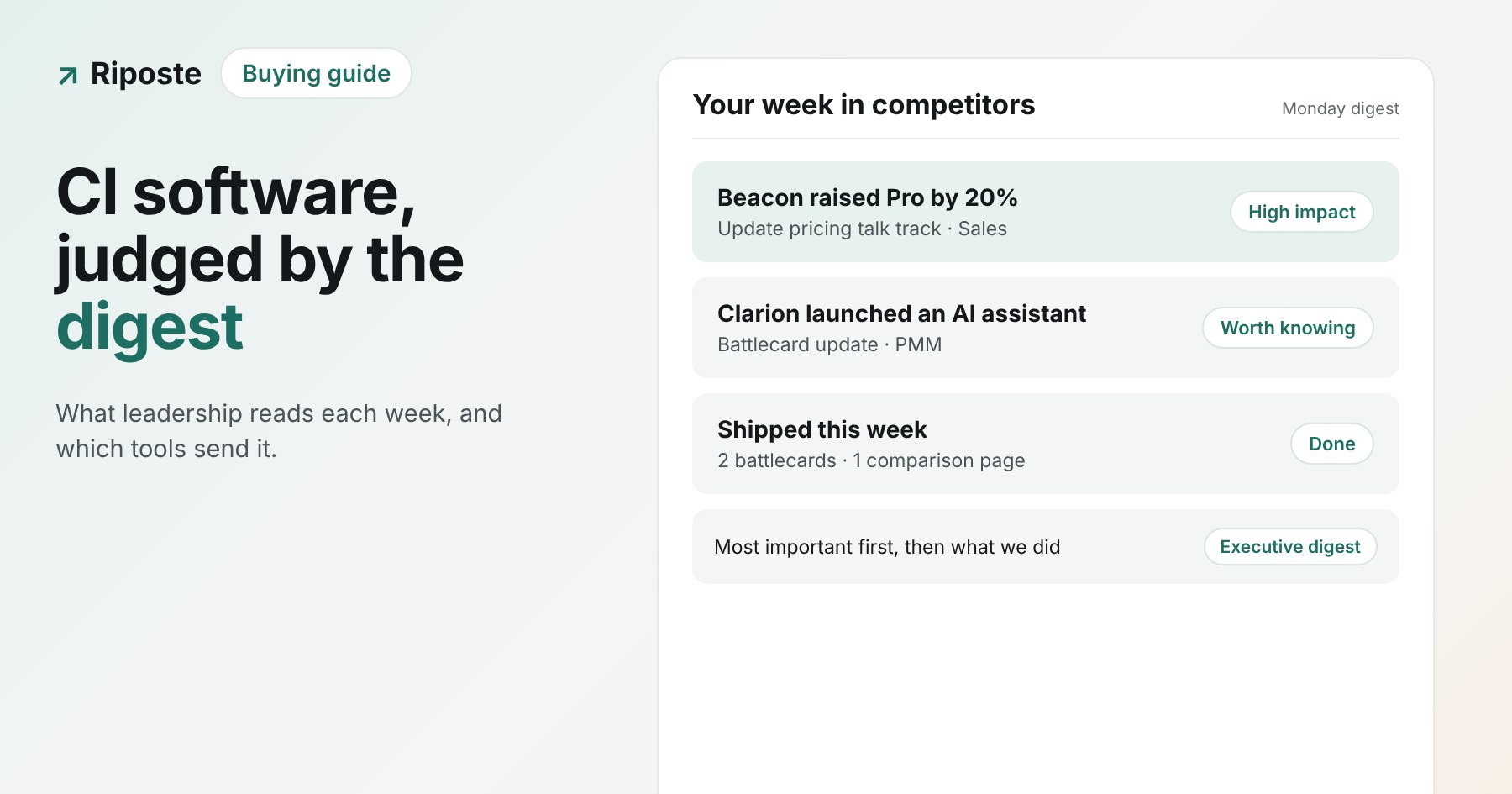
- Review drafts on a fixed day. With Riposte, the Monday digest lists last week's changes, most important first, plus what your team shipped and what's still open.
- Give every update one owner and one channel. For example: PMM updates the card, sales lead shares the talk track in #sales.
- Date every change on the card, so reps know it's current.
- Ask reps monthly what buyers said that isn't on the card yet. Their answers become the next objection replies.
Wrapping up
Competitive intelligence software for sales playbooks should be judged on one thing: how quickly a competitor change becomes a better battlecard, talk track and objection reply that reps trust. Large sales teams get that from platforms that live inside the CRM and learn from calls. Small marketing teams get it from a tool that does the daily checking and writes the first draft, so the product marketer's time goes into getting it right.
You can join the free Riposte beta at useriposte.com.
Sources
- Klue: official information page, checked 26 October 2026
- Klue for Salesforce, checked 23 October 2026
- Klue + Gong, checked 27 October 2026
- Klue: AI talk tracks, checked 27 October 2026
- Crayon: help sales reps win competitive deals, checked 27 October 2026
- Crayon + Salesforce, checked 27 October 2026
- Introducing Crayon Answers, checked 27 October 2026
- Kompyte: competitive intelligence and sales battlecards software, checked 27 October 2026
The bottom line
Judge competitive intelligence software for sales by how quickly a competitor change becomes a better battlecard, talk track and objection reply. Large sales teams need that inside the CRM; small marketing teams need the first draft written for them.
Frequently asked questions
How do competitive intelligence tools turn competitor updates into sales playbooks?
They spot a competitor change, judge how much it matters, and help you update what sales uses: the battlecard, the talk track and the objection reply. Some tools refresh battlecards inside sales tools, and some draft the update for a product marketer to review.
What is the difference between Klue, Crayon and Riposte?
Klue and Crayon are enterprise platforms for sales teams, with battlecards inside Salesforce and other sales tools, and Klue adds insights from Gong calls and win-loss. Riposte is a lighter tool for marketing teams of 1 to 5 people: it checks competitors' websites daily and drafts battlecard updates and talk tracks, with no CRM or Gong integration.
Can competitive intelligence software update battlecards automatically?
Partly. Klue says its battlecards are created and refreshed with AI, and Kompyte says a battlecard changed in one place updates everywhere it's shared. Riposte drafts the battlecard update when a competitor changes, and a person reviews it before sales sees it.
Which competitive intelligence tool fits a small B2B SaaS marketing team?
A lighter tool usually fits better than an enterprise platform. Riposte is built for B2B SaaS marketing teams of 1 to 5 people, tracks up to 5 competitors during its beta and is free during the beta.
Does Riposte integrate with Salesforce, HubSpot or Gong?
No. Riposte sends alerts by email and Slack and keeps the drafts in the app, where you copy them into your battlecards. If you need battlecards inside your CRM or insights from call recordings, Klue, Crayon or Kompyte fit better.
Can competitive intelligence software write objection replies?
It can draft them. Klue analyzes Gong calls to surface talk tracks and objection handling for PMMs to validate. Riposte drafts a talk track with one objection and its answer when a competitor changes something. A person should check every reply before reps use it.
How often should sales battlecards be updated?
Update a battlecard within a week of any competitor change that affects it, and review every card fully once a quarter. A card with a dated "last updated" line earns more trust from reps.
Which competitor sources matter most for sales playbooks?
Pricing pages, release notes or changelogs, blogs and news. Those are where most changes that make a battlecard wrong first show up.
Does Riposte monitor competitors' social media posts or ads?
No. Riposte watches competitors' websites, feeds, sitemaps, news and YouTube channels. If you need ad or social monitoring, Kompyte's site lists advertising among the things it tracks.
Is there a free way to create a sales battlecard?
Yes. Riposte's free battlecard generator drafts a one-page battlecard from a competitor's website, with no sign-up, up to 3 cards a day. Treat it as a first draft and add your own proof.