Saniya Gazala
In short
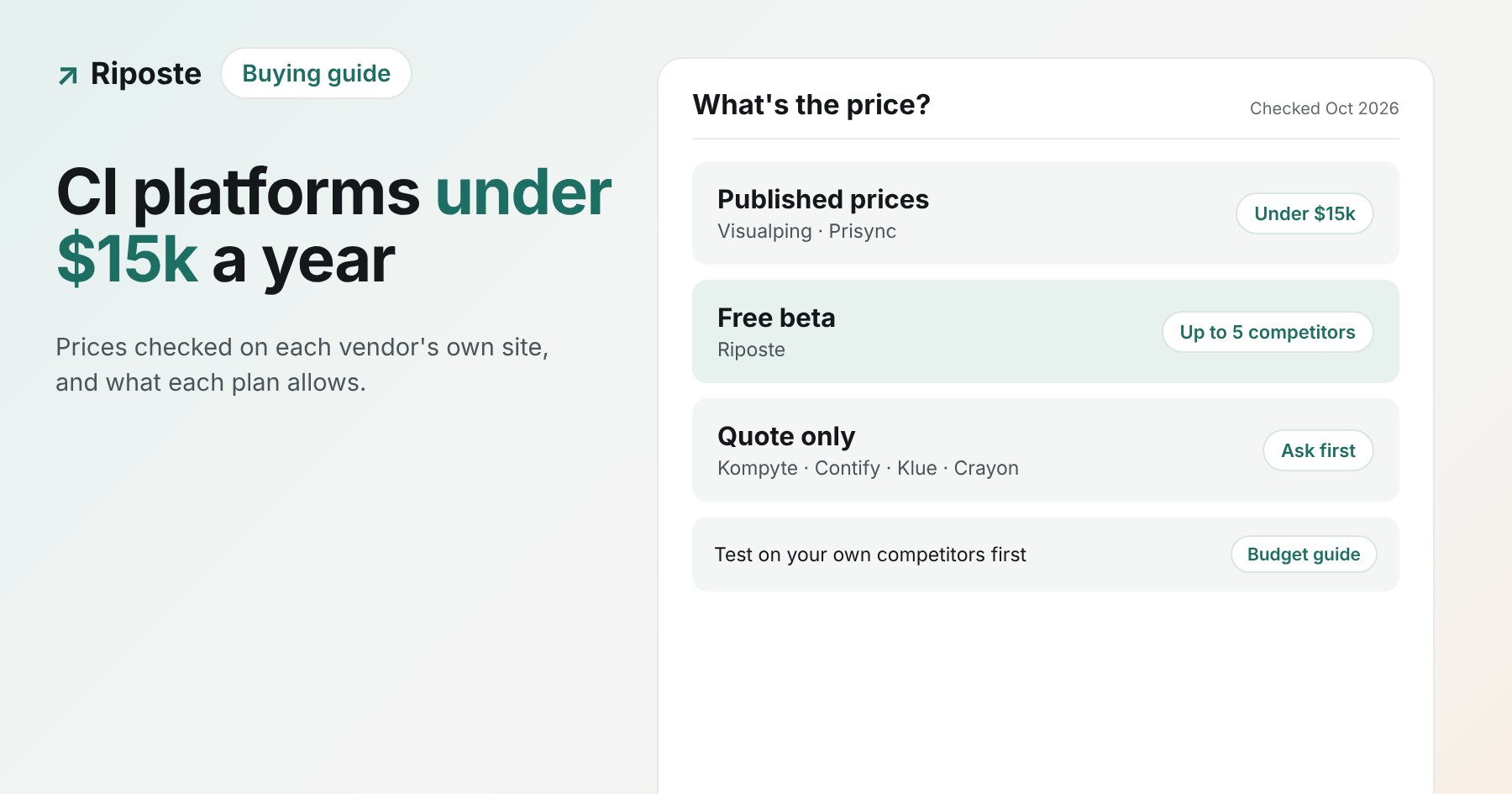
Of the tools in this guide, only Visualping, Prisync and Riposte publish prices under $15,000 a year: Visualping's paid plans run from $120 to $3,000 a year, Prisync's from $99 to $799 a month for online stores, and Riposte is free during its beta with no final price yet. Kompyte, Contify, Klue and Crayon don't publish prices, so you need a quote to know if they fit. Prices checked on each vendor's own site on 27 October 2026.
"Is it under budget?" is usually the first question about a competitive intelligence tool, and often the hardest to answer. Many CI vendors don't publish prices, and the ones that do price by very different things: seats, competitors, pages or products.
So for this guide I checked each vendor's own pricing page on 27 October 2026 and wrote down two things: the price, if it's public, and what the plan actually allows. Where a vendor doesn't publish a price, I say so instead of guessing whether it's under $15,000. I build one of these tools, Riposte, and I'll be clear about its limits too.
How competitive intelligence tools are priced
Before comparing numbers, check what the number is based on. The tools here use four different models:
- By competitors and licenses. Kompyte's plans track 10, 20 or unlimited companies, with 25, 100 or unlimited user licenses. Its plans page says price depends on the competitors tracked, the licenses, and whether you need single sign-on.
- By pages and checks. Visualping charges for how many pages you watch and how often it checks them, from 5 pages on the free plan to 500 on its largest Business plan.
- By products and sales channels. Prisync charges for how many products you track, and extra for each sales channel. It's built for online stores.
- By organization, with unlimited users. Contify offers unlimited user access, so you aren't paying per seat, but it doesn't publish a price.
The model matters as much as the price. A tool that charges per seat gets expensive the moment you want sales to read the intel. A tool that limits competitors gets expensive when your market is crowded.
Ask for the number before the demo
If a vendor doesn't publish prices, ask for a ballpark by email before you book a demo. A 30-minute call is a lot to spend on a tool that turns out to be five times your budget.
The tools at a glance
| Tool | Built for | Priced by | Price (checked 27 Oct 2026) |
|---|---|---|---|
| Visualping | Watching any page | Pages and check frequency | Free plan; paid $120 to $3,000 a year |
| Prisync | Online stores | Products and sales channels | $99 to $799 a month |
| Riposte | Teams of 1 to 5 marketers | Free beta, up to 5 competitors | Free during the beta, no final price yet |
| Kompyte | Go-to-market teams | Competitors, licenses, SSO | Not published, quote only |
| Contify | Organization-wide teams | Organization, unlimited users | Not published, demo or 7-day trial |
| Klue | B2B revenue teams | Not published | Not published, by demo |
| Crayon | CI, PMM and sales teams | Not published | Not published, by demo |
Visualping, Prisync, Kompyte and Contify checked on their own sites on 27 October 2026, Klue on 26 October and Crayon on 23 October 2026. Prices change, so check before you buy.
If you're comparing these one by one, I keep side-by-side pages for each on the compare hub.
The tools, one by one
Visualping
Visualping watches any page you choose and alerts you when it changes. It writes an AI summary of each change, and you can set criteria so it only alerts you about changes that matter to you.
- Free plan: 5 pages, checked every 60 minutes.
- Personal plans: $120 to $600 a year, for 10 to 40 pages.
- Business plans: $1,200 to $3,000 a year, for 200 to 500 pages, checked as often as every 2 minutes.
Good fit if you want to watch a few competitor pricing pages cheaply. Keep in mind that you add every page yourself, and you still decide what each change means for your product.
Prisync
Prisync tracks competitors' product prices for online stores. Its pricing page says it's built for ecommerce businesses.
- Plans: from $99 a month (100 products) to $799 a month (5,000 products), depending on the model.
- Competitors: the Professional plans list unlimited competitors.
- Extras: additional sales channels cost $100 to $200 a month each, and API access adds 20%.
- Trial: 14 days, no credit card.
Good fit if you sell products online and compete on price. Not a fit if you're a B2B SaaS company tracking competitors' pricing pages, launches and messaging: it's built around product catalogs.
Riposte
Riposte is the tool I build, for teams of 1 to 5 marketers. Every morning it checks your competitors' pricing pages, release notes, blogs and sitemaps, ignores noise, and turns each real change into a signal: what changed, why it matters for your product, and what to do.
- Price: free during the beta, with no final price yet.
- What the beta allows: up to 5 competitors.
- Alerts: high-impact changes by email and Slack, plus a weekly digest.
- Integrations: Slack and email only. There's no CRM integration.
Good fit if you're a small team that wants the response drafted, not just the alert. Not a fit if you need more than 5 competitors today, or battlecards inside your CRM.
Kompyte
Kompyte is competitive intelligence software offered with Semrush, for go-to-market teams. It tracks competitors' websites, builds battlecards and reports, and has automated workflows for sharing intel.
- Plans: Essentials (10 companies, 25 user licenses), Professional (20 companies, 100 licenses) and Unlimited (unlimited companies and licenses, with SSO).
- Price: not published. It offers annual plans, and says shorter terms "may be available for a premium".
Good fit if you already use Semrush or want battlecards for a sales team. Ask for a quote to see if it fits your budget. I keep a page on Kompyte alternatives if you're comparing it with lighter options.
Contify
Contify describes itself as an AI-native market and competitive intelligence platform for organization-wide teams, tracking markets, industries, competitors and key accounts.
- Price: not published.
- Users: unlimited user access, so no per-seat cost.
- Trial: a 7-day free trial, or a demo.
Good fit if several teams across the company need market and competitor news. Ask for a quote to see if it fits under $15,000.
Klue and Crayon
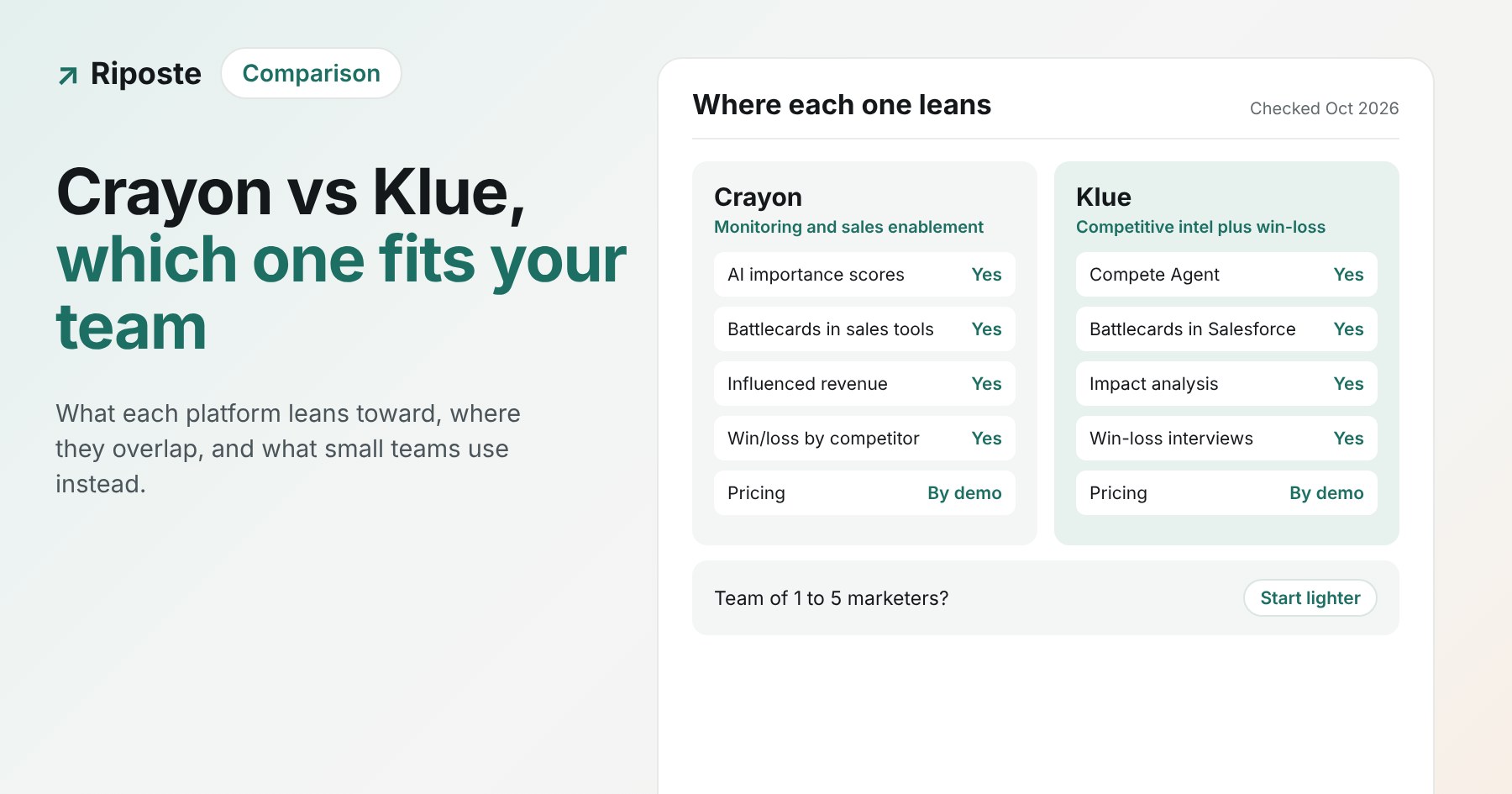
Klue and Crayon are the best-known enterprise platforms, built for revenue teams, with battlecards inside sales tools and win-loss features. Neither publishes prices, and both start with a demo, so I can't say whether either fits under $15,000. If you're weighing the two, I've compared them in Crayon vs Klue.
Alerts or action kits: what are you paying for?
Most tools in this price range send alerts. That's useful, but an alert is the start of the work, not the end. Someone still has to:
- Decide if it matters. Is a new pricing tier a threat, or noise?
- Decide what to do. Update the battlecard, brief sales, change a comparison page?
- Write it. Start the draft, and get it to the right people.
When you compare tools, ask which of those steps each one does for you. Some sort changes by impact (high, medium, low) so you read the important ones first. Some go further and draft the response. In Riposte, one click turns a change into an action kit: what to create, who owns it, where to share it, and a first draft to edit.
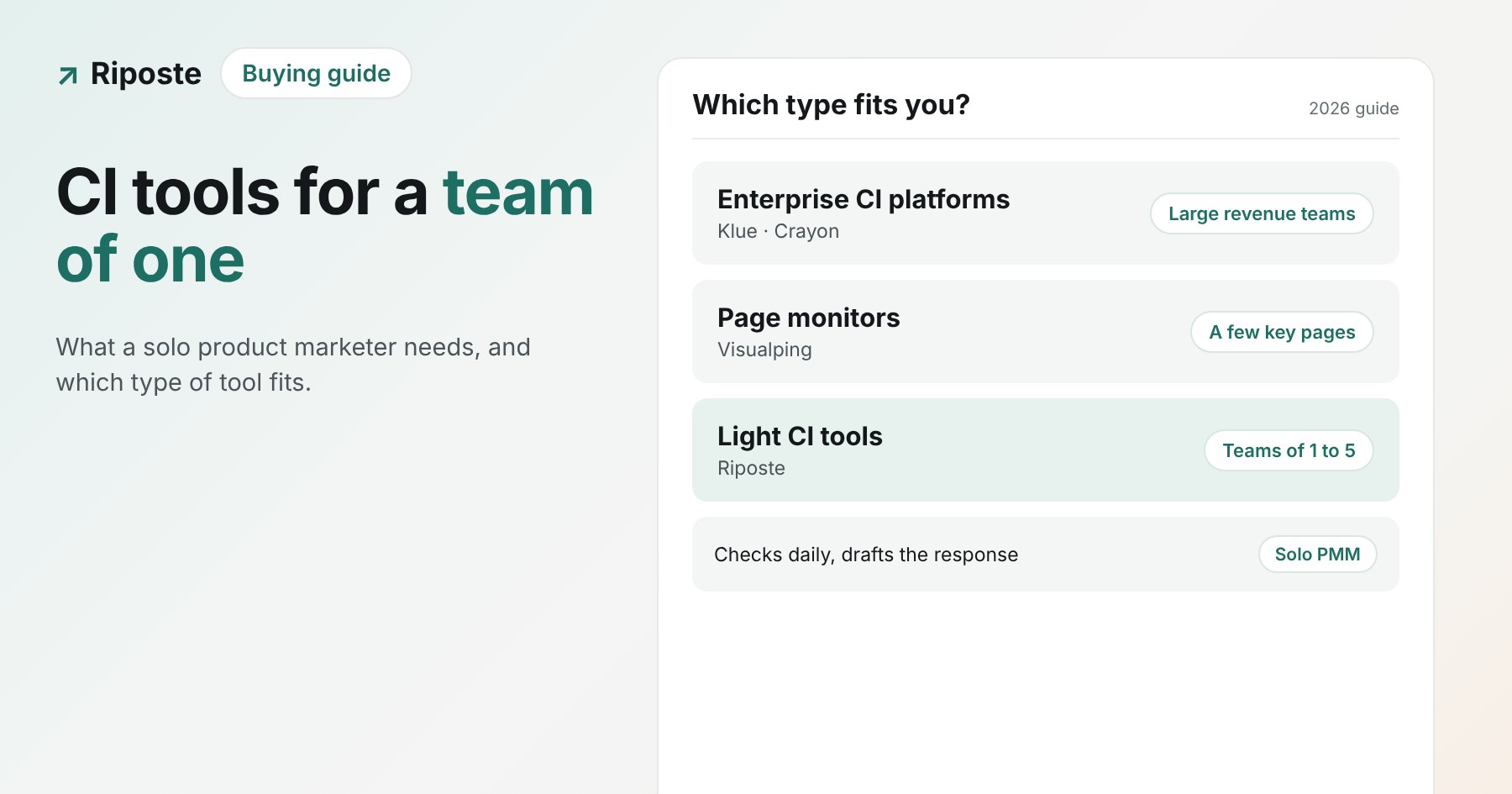
If you're the only marketer, this matters more than the feature list. I've written about it in competitive intelligence tools for a solo product marketer.
Don't forget AI visibility
Some buyers now ask an AI assistant which tool to use before they visit any website. Tracking competitors' pages won't show you what those answers say.
What to look for:
- Your buying questions, written without brand names, asked in an AI assistant.
- Which brands get named, and how often you appear next to competitors.
- Which sites the answers rely on, because those are worth getting listed on.
Riposte asks your prompts in Gemini with Google Search every week and records the brands named and the sites cited. AI answers change from run to run, so treat it as a trend.
How to choose under a $15,000 budget
- Start with your team. A dedicated CI manager can run a full platform. A busy PMM needs something that does the checking alone.
- Count your competitors. Then check what each plan allows: competitors, pages or products.
- Check the sources. Pricing pages, release notes, blogs and feeds matter most for B2B SaaS.
- Check how intel reaches people. Email, Slack, a CRM? Pick the tool that fits where your team already works.
- Get the real price. For quote-only tools, ask for a number before the demo.
- Test it on your own competitors. Use a free plan, a trial or a beta for a week before any annual contract.
Wrapping up
Under $15,000 a year, the first job is separating what you can verify from what you can't. Visualping, Prisync and Riposte publish what they cost and what they allow. Kompyte, Contify, Klue and Crayon need a quote. Whichever you test, judge it on your own competitors, and on how much of the work after the alert it takes off your plate.
Sources
- Visualping pricing, checked 27 October 2026
- How Visualping uses AI to monitor web changes, checked 26 October 2026
- Prisync plans, checked 27 October 2026
- Kompyte plans, checked 27 October 2026
- Kompyte on the Semrush knowledge base, checked 23 October 2026
- Contify platform, checked 27 October 2026
- Klue: official information page, checked 26 October 2026
- Crayon homepage, checked 23 October 2026
The bottom line
Under $15,000 a year, start with what you can verify: published prices, what each plan allows, and a free plan or trial on your own competitors. Ask quote-only vendors for a number before you spend time on a demo.
Frequently asked questions
What are the best competitive intelligence platforms under $15,000 a year?
Tools with published prices under $15,000 a year include Visualping ($120 to $3,000 a year on its paid plans), Prisync for online stores ($99 to $799 a month) and Riposte, which is free during its beta. Kompyte and Contify may fit too, but they don't publish prices, so you need a quote to know.
Which competitive intelligence tools allow unlimited competitor tracking?
Kompyte has an Unlimited plan with unlimited companies tracked, priced by quote. Prisync's Professional plans list unlimited competitors for up to 100 products, for online stores. Visualping limits pages rather than competitors, and Riposte tracks up to 5 competitors during its beta.
How much do Klue and Crayon cost?
Neither publishes prices. Both websites ask you to book a demo, so you need a quote for your team size and the features you need.
How much does Kompyte cost?
Kompyte doesn't publish prices. Its plans page says the price depends on the number of competitors tracked, the number of licenses, and whether you need single sign-on and advanced permissions. It offers annual plans.
How much does Riposte cost?
Riposte is free during its beta, and there is no final price yet. During the beta you can track up to 5 competitors.
Is there a free competitive intelligence tool?
Yes. Visualping has a free plan for 5 pages checked every 60 minutes, Riposte is free during its beta, and Google Alerts is free for news mentions. Contify offers a 7-day free trial and Prisync a 14-day free trial.
Does Riposte integrate with a CRM?
No. Riposte sends alerts by email and Slack, with a weekly digest, but it has no CRM integration. If you need battlecards inside Salesforce or HubSpot, a platform like Kompyte, Klue or Crayon fits better.
Can small B2B SaaS teams automate battlecards on a lean budget?
Yes, at least the first draft. A free battlecard generator can draft a one-page card from a competitor's website, and a tool like Riposte drafts battlecard updates when a competitor changes something. A person should still check every fact before sales uses it.
How do competitive intelligence tools track AI visibility in Gemini?
They ask the questions your buyers would ask an AI assistant and record which brands the answers name. Riposte asks your prompts in Gemini with Google Search every week and records the brands named and the sites cited, so you can watch the trend.
Is per-seat or per-competitor pricing better for a small team?
For a small team, pricing by competitors or pages is usually easier to predict, because you only have a few people but need the right competitors covered. Per-seat pricing gets expensive when you want sales to read the intel too, which is why some tools offer unlimited users.